|
 |
 |
 |
 |
 |
 |
 |
 |
 |

| . |  |
. |
Navy Awards Two Contracts For Airborne Low Frequency Sonar System
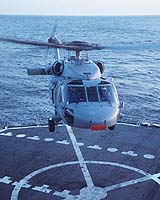
Tewksbury MA (SPX) Feb 22, 2007 Raytheon has been awarded a $50.8 million U.S. Navy contract for the Airborne Low Frequency Sonar system. Designated the AN/AQS-22, the system is the primary undersea warfare sensor for the U.S. Navy's MH-60R multi-mission helicopter. The company also received a subsequent $5.6 million contract for production sustaining support. AN/AQS-22 delivers significant undersea search, detection, and prosecution capabilities for the Navy's undersea warfare mission. "The performance of AN/AQS-22 continues to be outstanding," said U.S. Navy Capt. Paul Grosklags, program manager for Multi-Mission Helicopters. "This AN/AQS-22 production contract demonstrates the Navy's continued commitment to providing the fleet with the most reliable and highly capable undersea warfare weapons to meet current and future threats." Under the production contract, Raytheon Integrated Defense Systems (IDS) will manufacture, test, deliver and integrate 19 systems and provide associated services, support and weapon replaceable assemblies. Under the 2007 support contract, IDS will provide design, production and software support, technical documentation and integrated logistics support for the Navy's existing inventory of AN/AQS-22 systems. AN/AQS-22 provides critical undersea warfare mission support capabilities, including submarine detection, tracking, localization, classification, acoustic intercept, underwater communication and environmental data collection. Integrated Defense Systems has been the prime production supplier providing the U.S. Navy with these critical capabilities since 1999. This contract extends the program's full-rate production that has been accelerated since the initial fielding of the MH-60R helicopter into the U.S. Navy Fleet in 2006. Work will be performed at Raytheon's Maritime Mission Center in Portsmouth, R.I., and Thales Underwater Systems in Brest, France. Email This Article
Related Links  Balad Air Base, Iraq (AFNS) Feb 22, 2007
Iraq Eight aircrew members from the 332nd Air Expeditionary Wing's 777th Expeditionary Airlift Squadron used the joint precision airdrop system for the first time over Iraq Feb. 16 to deliver six 1,200-pound bundles. The Air Force developed the software and the Army developed the steerable chutes. The JPADS includes a wind sonde sensor, which is a 12- to 15-inch tube-shaped, beige-colored device that weighs no more than three pounds. |
|
|

| The content herein, unless otherwise known to be public domain, are Copyright 1995-2006 - SpaceDaily.AFP and UPI Wire Stories are copyright Agence France-Presse and United Press International. ESA PortalReports are copyright European Space Agency. All NASA sourced material is public domain. Additionalcopyrights may apply in whole or part to other bona fide parties. Advertising does not imply endorsement,agreement or approval of any opinions, statements or information provided by SpaceDaily on any Web page published or hosted by SpaceDaily. Privacy Statement |