|
 |
 |
 |
 |
 |
 |
 |
 |
 |

| . |  |
. |
New Light On Muscle Efficiency
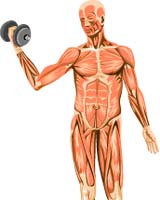
Odense, Denmark (SPX) Mar 28, 2006 A recent study from Scandinavia shows that the well-known differences between individuals in the efficiency of converting energy stored in food to work done by muscles are related to muscle fibre type composition and to the content of specific molecules in muscle. When muscles contract they use energy that is derived from food. It is a two-step process. The first step occurs in mitochondria, where the energy from molecules like glucose or fats is locked away in ATP (adenosine triphosphate). This ATP travels from the mitochondria to sites in the muscle where energy is needed, and the energy is released and used. At both of these stages there is the possibility for energy to be lost, causing a reduction in efficiency. The proportion of food energy that ends up making the muscles move is a measure of the efficiency of the system, and this is known to vary considerably between people. The main theory is that this variation comes from differences in the efficiency with which mitochondria convert food energy to ATP. But results published in this fortnight's edition of The Journal of Physiology indicate that any differences in the efficiency of individual mitochondria cannot explain the differences in overall efficiency between people. Consequently these differences must lie in the way the ATP is used within the muscle. The research was carried out on healthy human volunteers by a team of scientists working at the University of Southern Denmark, Odense, and the Karolinska Institute/GIH, in Stockholm, Sweden. It combined exercise testing of individuals, with laboratory analysis of muscle samples. The results showed that work efficiency was correlated with muscle fibre type composition and with the amount of UCP3 protein � muscles with high proportions of this protein had lower efficiencies than those with low proportions. "It's too early to say whether UCP3 causes this difference, or whether it is a marker of some other process, but further research might someday lead to training strategies that will help us improve efficiency, or identify subjects who have the potential to become more efficient over time," says lead author Martin Mogensen. "The work is an excellent example of integrative physiology, addressing questions both at the sub-cellular and whole body levels that have implications for basic muscle energetics as well as athletic performance," says Professor Edward Coyle, of the University of Texas at Austin, in an accompanying editorial. Related Links University of Southern Denmark Karolinska Institute Journal of Physiology  Pitt Researchers Find Switch For Brains Pleasure Pathway
 Pittsburgh PA (SPX) Mar 24, 2006
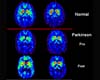
Findings could help identify cause of schizophrenia, Parkinson's, drug addiction Amid reports that a drug used to treat Parkinson's disease has caused some patients to become addicted to gambling and sex, University of Pittsburgh researchers have published a study that sheds light on what may have gone wrong. |
|
|

| The content herein, unless otherwise known to be public domain, are Copyright 1995-2006 - SpaceDaily.AFP and UPI Wire Stories are copyright Agence France-Presse and United Press International. ESA PortalReports are copyright European Space Agency. All NASA sourced material is public domain. Additionalcopyrights may apply in whole or part to other bona fide parties. Advertising does not imply endorsement,agreement or approval of any opinions, statements or information provided by SpaceDaily on any Web page published or hosted by SpaceDaily. Privacy Statement |