
 |
 |
 |
 |
 |
 |
 |
 |
 |
 |

| . |  |
. |

Livermore, CA (SPX) May 20, 2011 By combining high pressure with high temperature, Livermore researchers have created a nanocyrstalline diamond aerogel that could improve the optics for something as big as a telescope or as small as the lenses in eyeglasses. Aerogels are a class of materials that exhibit the lowest density, thermal conductivity, refractive index and sound velocity of any bulk solid. Aerogels are among the most versatile materials available for technical applications due to their many exceptional properties. This material has chemists, physicists, astronomers, and materials scientists utilizing its properties in myriad applications, from a water purifier for desalinizing seawater to installation on a NASA satellite as a meteorite particle collector. In new research appearing in the May 9 online edition of the Proceedings of the National Academy of Sciences, a Livermore team created a diamond aerogel from a standard carbon-based aerogel precursor using a laser-heated diamond anvil cell. A diamond anvil cell consists of two opposing diamonds with the sample compressed between them. It can compress a small piece of material (tens of micrometers or smaller) to extreme pressures, which can exceed 3 million atmospheres. The device has been used to recreate the pressure existing deep inside planets, creating materials and phases not observed under normal conditions. Since diamonds are transparent, intense laser light also can be focused onto the sample to simultaneously heat it to thousands of degrees. The new form of diamond has a very low density similar to that of the precursor of around 40 milligrams per cubic centimeter, which is only about 40 times denser than air. The diamond aerogel could have applications in antireflection coatings, a type of optical coating applied to the surface of lenses and other optical devices to reduce reflection. Less light is lost, improving the efficiency of the system. It can be applied to telescopes, binoculars, eyeglasses or any other device that may require reflection reduction. It also has potential applications in enhanced or modified biocompatibility, chemical doping, thermal conduction and electrical field emission. In creating diamond aergoels, lead researcher Peter Pauzauskie, a former Lawrence fellow now at the University of Washington, infused the pores of a standard, carbon-based aerogel with neon, preventing the entire aerogel from collapsing on itself. At that point, the team subjected the aerogel sample to tremendous pressures and temperatures (above 200,000 atmospheres and in excess of 2,240 degrees Fahrenheit), forcing the carbon atoms within to shift their arrangement and create crystalline diamonds. The success of this work also leads the team to speculate that additional novel forms of diamond may be obtained by exposing appropriate precursors to the right combination of high pressure and temperature. Livermore researchers on the project include: Jonathan Crowhurst, Marcus Worsley, Ted Laurence, Yinmin "Morris" Wang, Trevor Wiley, Kenneth Visbeck, William Evans, Joseph Zaug and Joe Satcher Jr.
Share This Article With Planet Earth
Related Links Lawrence Livermore National Laboratory Carbon Worlds - where graphite, diamond, amorphous, fullerenes meet

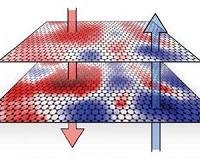 2 graphene layers may be better than 1
Washington DC (SPX) Apr 29, 2011 Researchers at the National Institute of Standards and Technology (NIST) have shown that the electronic properties of two layers of graphene vary on the nanometer scale. The surprising new results reveal that not only does the difference in the strength of the electric charges between the two layers vary across the layers, but they also actually reverse in sign to create randomly distribut ... read more |
|
|
| The content herein, unless otherwise known to be public domain, are Copyright 1995-2010 - SpaceDaily. AFP and UPI Wire Stories are copyright Agence France-Presse and United Press International. ESA Portal Reports are copyright European Space Agency. All NASA sourced material is public domain. Additional copyrights may apply in whole or part to other bona fide parties. Advertising does not imply endorsement,agreement or approval of any opinions, statements or information provided by SpaceDaily on any Web page published or hosted by SpaceDaily. Privacy Statement |


 del.icio.us
 Digg
Digg Reddit
 YahooMyWeb
 Google
 Facebook


