|
 |
 |
 |
 |
 |
 |
 |
 |
 |

| . |  |
. |
Next-Generation Solar Cells Could Put Power Stations In Space
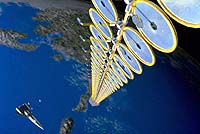
Rochester - Jan 08, 2003 Someday, large-scale solar power stations in space could beam electricity to the surface of the moon, the earth and other planets, decreasing our dependence on a dwindling fossil-fuel supply. Scientists at Rochester Institute of Technology are developing the next generation of solar cells, advancing the technology that could put a solar power system into earth's orbit. The National Science Foundation recently awarded a three-year, $200,000 grant to Ryne Raffaelle and Thomas Gennett, co-directors of RIT's NanoPower Research Laboratory, to develop nanomaterials--no bigger than a billionth of a meter--in support of NASA's space solar power program. The notion of space solar power--discounted as farfetched and silly after the energy crunch of the 1970s--never completely went away. Some scientists and other visionaries remained intrigued by the idea of orbiting, football-field sized "blankets" of solar cells that could generate tremendous amounts of power. NASA's program is revisiting the idea, pushing the latest technology as far as it will go. Raffaelle and Gennett are working with scientists from the Ohio Aerospace Institute and Phoenix Innovations Inc. to develop a new-and-improved solar cell that is light, thin and highly efficient. This solar cell, a thin-film device, will sandwich tiny granules of semi-conductor material, known as Quantum dots, and carbon nanotubes. "In order to put football-field sized arrays in space, they need to be lightweight and flexible, and able to withstand the rigors of space," Raffaelle says. "Today's technology isn't good enough, but with the theoretical possibilities offered by nanomaterials it could become a reality." Gennett adds: "The types of solar cells that we are working to develop are a clear departure from even the most advanced crystalline solar cells used in the space industry today. If we are successful it will result in a complete paradigm shift in space solar power generation." Related Links Rochester Institute of Technology SpaceDaily Search SpaceDaily Subscribe To SpaceDaily Express  Canada Pursues Micro Fuel cell technology
 Edmonton - Nov 15, 2002
A first in Canada, the Alberta Research Council (ARC) reached a milestone in the technical development of its own version of solid oxide fuel cell (SOFC) technology. ARC scientists are developing a proprietary micro solid oxide fuel cell (�-SOFC) source of energy for small-scale portable applications such as laptops or personal digital assistants (PDAs). |
|
|

| The content herein, unless otherwise known to be public domain, are Copyright 1995-2006 - SpaceDaily.AFP and UPI Wire Stories are copyright Agence France-Presse and United Press International. ESA PortalReports are copyright European Space Agency. All NASA sourced material is public domain. Additionalcopyrights may apply in whole or part to other bona fide parties. Advertising does not imply endorsement,agreement or approval of any opinions, statements or information provided by SpaceDaily on any Web page published or hosted by SpaceDaily. Privacy Statement |