
 |
 |
 |
 |
 |
 |
 |
 |
 |
 |

| . |  |
. |
Outer Solar System Not So Crowded
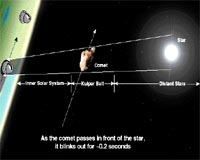
Boston MA (SPX) Oct 08, 2008 When a treasure hunt comes up empty-handed, the hunters are understandably disappointed. But when astronomers don't find what they are looking for, the defeat can provide as much information as a successful search. The search in question, the Taiwanese-American Occultation Survey (TAOS), spent two years periodically photographing portions of the sky to look for small chunks of rock and ice orbiting beyond Neptune, in a region of the solar system called the Kuiper Belt. The survey targeted Kuiper Belt objects (KBOs) with sizes between 2 miles (3 km) and 17 miles (28 km). Since such objects are too small to see directly, the survey watched for stars to dim as KBOs passed in front of and occulted them. After accumulating more than 200 hours of data watching for stellar flickers lasting a second or less, TAOS did not spot any occultations. The Kuiper Belt contains objects in a range of sizes: a few very large ones (like the dwarf planets Pluto, Eris, Makemake and Haumea) and many more smaller ones. The commonness of a given size tells us information about the history of planet formation and dynamics. In particular, the size distribution of KBOs reflects a history of agglomeration, in which colliding objects tended to stick together, followed by destructive collisions, where collisional velocities were high enough to shatter the rocks involved. Astronomers questioned whether they would find more and more objects as sizes decreased further, or whether the distribution leveled out. The fact that no occultations were seen sets a stringent upper limit on the number density of KBOs between 2 and 17 miles in diameter. The outer solar system hence appears not as crowded as some theories suggest, perhaps because small KBOs have already stuck together to form larger bodies or frequent collisions have ground down small KBOs into even smaller bits below the threshold of the survey. Community Email This Article Comment On This Article Share This Article With Planet Earth
Related Links Harvard-Smithsonian Center for Astrophysics (CfA) The million outer planets of a star called Sol
 NASA Spacecraft Ready To Explore Outer Solar System
 Washington DC (SPX) Oct 07, 2008
The first NASA spacecraft to image and map the dynamic interactions taking place where the hot solar wind slams into the cold expanse of space is ready for launch Oct. 19. The two-year mission will begin from the Kwajalein Atoll, a part of the Marshall Islands in the Pacific Ocean. |
|
|

| The content herein, unless otherwise known to be public domain, are Copyright 1995-2007 - SpaceDaily.AFP and UPI Wire Stories are copyright Agence France-Presse and United Press International. ESA Portal Reports are copyright European Space Agency. All NASA sourced material is public domain. Additional copyrights may apply in whole or part to other bona fide parties. Advertising does not imply endorsement,agreement or approval of any opinions, statements or information provided by SpaceDaily on any Web page published or hosted by SpaceDaily. Privacy Statement |
 del.icio.us
 Digg
Digg Reddit
 YahooMyWeb
 Google
 Facebook