
 |
 |
 |
 |
 |
 |
 |
 |
 |
 |

| . |  |
. |
Perseids Meteor Shower Creates September Surprise
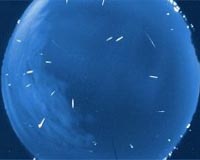
Huntsville AL (SPX) Sep 16, 2008 An unexpected flock of fireballs burst over the eastern United States early Sept. 9, but sharp-eyed Marshall Center astronomers were on the case. Lasting almost four hours, the shower contained about 25 meteors that were as bright as Jupiter and Venus in the morning sky. Early analysis suggests that NASA's photos are the first-ever observed outburst of the September Perseids, which result from an unknown comet. A meteor is a bright streak of light that appears briefly in the sky, occurring when a particle or chunk of metallic or stony matter called a meteoroid enters the earth's atmosphere from outer space. Air friction heats the meteoroid so that it glows and creates a shining trail of gases and melted meteoroid particles. The gases include vaporized meteoroid material and atmospheric gases that heat up when the meteoroid passes through the atmosphere. Most meteors are visible for about a second. Observers often call meteors shooting stars or falling stars because they look like stars falling from the sky. The brightest meteors -- those brighter than the planet Jupiter -- are called fireballs. William Cooke, Meteoroid Environments Office, NASA's Marshall Space Flight Center, reports from single station all-sky video observations a significant outburst of bright meteors on September 9 between 1:20 am and 5:30 am Central Daylight Time. In total, some 25 meteors of apparent magnitude greater than -2 were detected from a single radiant during this four hour interval. This is an apparent rate of such events exceeding the Perseid peak, suggestive of ZHRs about 100. An approximate apparent radiant is found to be at alpha = +50 and delta = +43. The timing and radiant are consistent with an outburst from the September Perseid meteor shower. Community Email This Article Comment On This Article Share This Article With Planet Earth
Related Links View Video of Perseids Shower NASA Worldbook: Meteors Asteroid and Comet Impact Danger To Earth - News and Science
 Amateur Astronomers See Perseids Hit The Moon
 Huntsville AL (SPX) Sep 03, 2008
There's more than one way to watch a meteor shower. One, the old-fashioned way: Find a dark place with starry skies and count the meteors streaking overhead. Two, the new way: Find a dark place with starry skies and then completely ignore the meteors. Instead, watch the Moon. That's where the explosions are. |
|
|

| The content herein, unless otherwise known to be public domain, are Copyright 1995-2007 - SpaceDaily.AFP and UPI Wire Stories are copyright Agence France-Presse and United Press International. ESA Portal Reports are copyright European Space Agency. All NASA sourced material is public domain. Additional copyrights may apply in whole or part to other bona fide parties. Advertising does not imply endorsement,agreement or approval of any opinions, statements or information provided by SpaceDaily on any Web page published or hosted by SpaceDaily. Privacy Statement |
 del.icio.us
 Digg
Digg Reddit
 YahooMyWeb
 Google
 Facebook