|
 |
 |
 |
 |
 |
 |
 |
 |
 |

| . |  |
. |
Physicists Create New Telescope To Explain Solar Flares and More
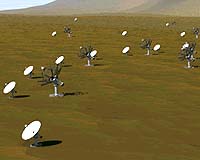
Newark - Jan 6, 2003 A new day is dawning for solar radio physics, thanks to advances in microwave and computer chip technology that enable the construction of radiotelescopes with new capabilities and greater sensitivity. The importance of this specialized area has expanded because scientists want to access more information about solar flares. Such flares can interfere with wireless communication, damage satellites in Earth's orbit, disrupt airline schedules and more. To facilitate this research, New Jersey Institute of Technology (NJIT) is leading a design study for the Frequency Agile Solar Radiotelescope (FASR). The FASR project, that will ultimately create 100 receiving dishes, was recently ranked number one in importance by the influential NRC Solar and Space Physics Survey Committee of the National Academy of Sciences. The FASR study is a joint project of NJIT, the National Radio Astronomy Observatory (NRAO), University of Maryland and the University of California at Berkeley. Principal investigator for the study, Dale Gary, Ph.D., a physics professor at NJIT, says that the ranking signals recognition by the scientific community of the potential of solar radio physics. "To date, solar radio physics in the United States has progressed by using telescopes designed for other purposes," says Gary. "The technology was too expensive to justify a telescope designed specifically to investigate the sun. However, the technology has matured and, in turn, has become less expensive and more capable. It is financially within our reach to use radio techniques to learn more about the sun and how its magnetic fields release energy." The focus of Gary's team of physicists will be to construct a new radio telescope capable of making high-resolution images of the solar corona, the glowing gas that can be seen surrounding the sun during a solar eclipse. The radio images will allow the scientists to make direct measurements of the coronal magnetic fields. Solar physicists want to know more about the magnetic fields because they are often cited as the culprit behind potentially damaging outbursts from the sun such as solar flares and coronal mass ejections. Such ejections sometimes throw matter and magnetic fields toward Earth that can cause dangerous radiation levels in space, and, if they hit Earth, can trigger magnetic storms. The storms, fueled by the collision between the mass ejection and Earth's magnetic field, cause auroras, or northern lights, in regions normally limited to the Earth's poles. However, particularly severe storms cause the auroras to spread southward and if they do, they can destroy power transformers and disrupt some forms of radio communication. Until now they have been difficult to predict, says Gary. Such storms occur ten times a year and occasionally can be troublesome. For example, in 1989, one storm plunged the Hydro Quebec power grid, which serves 6 million Canadians, into a blackout affecting the entire province. The new radio telescope will study the birth of coronal mass ejections, especially those on the near face of the sun that most affect Earth, perhaps leading to the ability to predict their severity and when they will occur. This is especially important because of the high-energy particles that accompany coronal mass ejections. These particles have the potential to destroy satellites. The satellites in turn may impact television viewing, pagers, cellular phones and more. Such storms can also impact airline flights. Since the demise of the former Soviet Union, airlines now regularly fly polar routes over Siberia. Those flights, however, must be cancelled on short notice if they might encounter a solar storm caused by sun activity. The storm produces dangerous levels of radiation for airline crews, who regularly fly this route. "Suddenly we see an increasing interest in learning how to forecast solar storms because airlines, aiming to protect employees, prefer to steer clear of them," says Gary. The telescopes Gary and his colleagues build will be designed to help space forecasters who are responsible for providing information on the space environment, which is used by airlines, power companies and even satellite operators. The latter control satellite networks that provide television programming and other services to consumers. Better knowledge about solar activity may also enable astronauts to finally land on Mars. "Currently such a flight is very difficult because it requires a very long duration in space," says Gary. "To make such a flight possible, we must understand the environment of the weather in space. The particles one of these storms stir up can be deadly if you are unprotected." In January of 2002, the FASR Consortium project received a $400,000 grant from the National Science Foundation (NSF) for a design study that has since been approved. The study began in March of 2002. Related Links The Frequency-Agile Solar Radiotelescope SpaceDaily Search SpaceDaily Subscribe To SpaceDaily Express  New Theory Unravels Magnetic Instability
 Los Alamos - Dec 17, 2002
Reconnection, the merging of magnetic field lines of opposite polarity near the surface of the sun, Earth and some black holes, is believed to be the root cause of many spectacular astronomical events such as solar flares and coronal mass ejections, but the reason for this is not well understood. Researchers at Los Alamos National Laboratory now have a new theory that may explain the instability and advance the understanding of these phenomena.
--------------------------------------------------------- It's new. And it's downright terrific! Celestron's CPC Schmidt-Cassegrain telescope is the scope you've been waiting for! It offers new alignment technology, advanced engineering, and bold new design at a new, low price! In fact, Celestron's Professional Computerized (CPC) scope with revolutionary SkyAlign Alignment Technology redefines everything that amateur astronomers are looking for. It offers quick and simple alignment, GPS technology, unsurpassed optical quality, ease of use, advanced ergonomics, enhanced computerization and, most important, affordability. Want to view M-31 tonight? One button takes you there!
Shop for telescopes online at Telescopes.com! today!
|
|
|

| The content herein, unless otherwise known to be public domain, are Copyright 1995-2006 - SpaceDaily.AFP and UPI Wire Stories are copyright Agence France-Presse and United Press International. ESA PortalReports are copyright European Space Agency. All NASA sourced material is public domain. Additionalcopyrights may apply in whole or part to other bona fide parties. Advertising does not imply endorsement,agreement or approval of any opinions, statements or information provided by SpaceDaily on any Web page published or hosted by SpaceDaily. Privacy Statement |