|
 |
 |
 |
 |
 |
 |
 |
 |
 |

| . |  |
. |
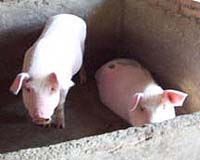
Pigs In Space
Sydney, Australia (SPX) Jul 19, 2005 Information on the upcoming Shenzhou 6 mission is gradually trickling out from official sources, as the launch date for the mission draws closer. As usual, China remains very guarded about the overall program that's planned for the flight, but the little we have learned from a recent media statement gives us scope for some speculation. China is still being vague about the launch date and the precise duration of the mission, with some sources citing September, while others say the mission will fly in early October. The duration of the flight still seems to range from four to five days, depending on the sources consulted, and how the sources are interpreted. Such vagueness is possibly the result of a secrecy policy, but it could also reflect uncertainties by mission planners. An exact launch date has probably not been fixed at the present. China has probably allocated a launch window of roughly a month, spanning September and October, for the flight. This will allow tracking ships and station crews to be ready, hopefully in a period when weather conditions for the flight, and the marine vessels that support it, will be calm. But the exact date and time of launch will probably be determined only when planners are satisfied that every part of the system is ready. Recent events in returning the space shuttle to flight lend support to the usefulness of such an approach. China has also released information on another simple experiment to be flown on Shenzhou 6, noting that pig spermatozoa will be carried on the spacecraft. The spermatozoa will be returned to Earth and used in breeding experiments, through in-vitro fertilisation. Biologists will search for any genetic changes in the resultant "space pigs" that could be caused by exposure to cosmic rays. As a scientific experiment, the pig spermatozoa flight has much to recommend it. It's light, non-hazardous, and probably requires little intervention by the crew. Searching for genetic mutations caused by radiation in space could be useful for China's enormous pork industry, but the experiment will also have implications for human spaceflight. Genetic mutations experienced by these mammals could, in theory, be extrapolated to potential mutations in human astronauts. China's pig experiments will evidently help with the planning of long-term missions in orbit, or trips to the moon. As with China's legendary program of flying agricultural seeds in space, the pig experiment forges links between the lofty activity of astronautics and China's rural economy, making the flight more practical. But China has decided to take its pig experiment one step further. Two samples of pig spermatozoa will be carried, each at a different place on the spacecraft. In theory, each sample will receive different levels of radiation exposure, and could exhibit different patterns of mutations. This is scientifically sound, and suggests that China is also interested in checking the performance of radiation shielding on Shenzhou. Exactly how the samples will be stowed, however, is not entirely clear from Chinese media statements. Chinese media reports say that one sample will be placed inside the "biological capsule", which presumably means the bell-shaped descent module occupied by the crew during re-entry. Placing a sample in the descent module would ensure that it would return to Earth without the need for the crew to perform any activities. China states that the other sample "will be put outside". This suggests that a container holding the sample will be attached to the exterior of the spacecraft. But where? It could be stored on the exterior of the descent module, in a hardened container that will protect the sample during re-entry. But this would be difficult. The spermatozoa could be exposed to high temperatures, and an external container on the side of the descent module would affect its aerodynamic properties. China is unlikely to risk the safety of the crew during the descent phase for a simple experiment. The only other likely location for storing the sample is on the exterior of the cylindrical Orbital Module at the front of the spacecraft. But any sample placed outside the spacecraft would need to be retrieved, then transferred to the Descent Module to ensure a safe return to Earth. How would this happen? China has stated that no spacewalking will take place on this flight, but this would not be needed to retrieve a sample. The most likely method would involve the use of a small scientific airlock in the Orbital Module. The sample would be placed inside the airlock by the crew soon after launch, then extended into space using a robotic boom. Towards the end of the flight, the crew would retract the boom, close the airlock, and retrieve the sample. The airlock itself could be a small, boxy device similar in size to a microwave oven. Where would such an airlock be placed? There are two large portals on the side of the Orbital module. One is a hatch for crew ingress, the other is a window. Neither of these would probably be compromised. But the front of the orbital module has hosted a variety of devices on successive Shenzhou missions, from cameras to antenna arrays. This is the most likely location for a scientific airlock. If this is the case, it is unlikely that Shenzhou 6 will carry an imaging camera at the front of the orbital module, or any of the previous "front end" payloads. Clearance would need to be provided for the airlock hatch and the emerging sample. Thus, China has indirectly given us clues to the spacecraft architecture that will be flown. China will hopefully release more information soon. The mission gets more interesting with each new fact. Dr Morris Jones can be contacted at morrisjonesNOSPAMhotmail.com. Replace NOSPAM with @ to send email. Related Links SpaceDaily Search SpaceDaily Subscribe To SpaceDaily Express  China To Send Pig 'Eggs' Into Space
 Beijing (AFP) Jul 17, 2005
China plans to take 'eggs' from pedigree pigs on its second manned space mission to study whether exposure to outer space alters the genetic make-up of the 'eggs', state media said Sunday. |
|
|

| The content herein, unless otherwise known to be public domain, are Copyright 1995-2006 - SpaceDaily.AFP and UPI Wire Stories are copyright Agence France-Presse and United Press International. ESA PortalReports are copyright European Space Agency. All NASA sourced material is public domain. Additionalcopyrights may apply in whole or part to other bona fide parties. Advertising does not imply endorsement,agreement or approval of any opinions, statements or information provided by SpaceDaily on any Web page published or hosted by SpaceDaily. Privacy Statement |