
 |
 |
 |
 |
 |
 |
 |
 |
 |
 |

| . |  |
. |
Plutoid Chosen As Name For Solar System Objects Like Pluto
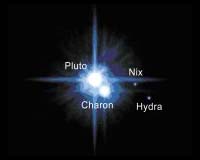
Paris, France (SPX) Jun 12, 2008 The International Astronomical Union has decided on the term plutoid as a name for dwarf planets like Pluto at a meeting of its Executive Committee in Oslo. Almost two years after the International Astronomical Union (IAU) General Assembly introduced the category of dwarf planets, the IAU, as promised, has decided on a name for transneptunian dwarf planets similar to Pluto. The name plutoid was proposed by the members of the IAU Committee on Small Body Nomenclature (CSBN), accepted by the Board of Division III, by the IAU Working Group for Planetary System Nomenclature (WGPSN) and approved by the IAU Executive Committee at its recent meeting in Oslo, Norway. Plutoids are celestial bodies in orbit around the Sun at a distance greater than that of Neptune that have sufficient mass for their self-gravity to overcome rigid body forces so that they assume a hydrostatic equilibrium (near-spherical) shape, and that have not cleared the neighbourhood around their orbit. The two known and named plutoids are Pluto and Eris. It is expected that more plutoids will be named as science progresses and new discoveries are made. The dwarf planet Ceres is not a plutoid as it is located in the asteroid belt between Mars and Jupiter. Current scientific knowledge lends credence to the belief that Ceres is the only object of its kind. Therefore, a separate category of Ceres-like dwarf planets will not be proposed at this time. The IAU has been responsible for naming planetary bodies and their satellites since the early 1900s. The IAU CSBN, who originally proposed the term plutoid, is responsible for naming small bodies (except satellites of the major planets) in the Solar System. The CSBN will be working with the IAU WGPSN to determine the names of new plutoids to ensure that no dwarf planet shares the name of another small Solar System body. The WGPSN oversees the assignment of names to surface features on bodies in the Solar System. These two committees have previously worked together to accept the names of dwarf planet Eris and its satellite Dysnomia. In Oslo, members of the IAU also discussed the timing involved with the naming of new plutoids. Again, following the advice of the Division III Board and the two Working Groups, it was decided that, for naming purposes, any Solar System body having (a) a semimajor axis greater than that of Neptune, and (b) an absolute magnitude brighter than H = +1 magnitude will be considered to be a plutoid, and be named by the WGPSN and the CSBN. Name(s) proposed by the discovery team(s) will be given deference. If further investigations show that the object is not massive enough and does not qualify as a plutoid, it will keep its name but change category. In French plutoid is plutoide, in Spanish plutoide and in Japanese ... (See the above link for the French accent marks and Japanese translation.) Community Email This Article Comment On This Article Share This Article With Planet Earth
Related Links IAU Pluto and the other dwarf planets The million outer planets of a star called Sol
 New Horizons Set To Cut Cross Saturn Orbit
 Washington DC (SPX) Jun 03, 2008
Last week, New Horizons woke up from its longest electronic hibernation period to date - 89 days. And over the next 10 days, the New Horizons team will celebrate a trio of milestones on the spacecraft's long journey to explore Pluto in 2015. |
|
|

| The content herein, unless otherwise known to be public domain, are Copyright 1995-2007 - SpaceDaily.AFP and UPI Wire Stories are copyright Agence France-Presse and United Press International. ESA Portal Reports are copyright European Space Agency. All NASA sourced material is public domain. Additional copyrights may apply in whole or part to other bona fide parties. Advertising does not imply endorsement,agreement or approval of any opinions, statements or information provided by SpaceDaily on any Web page published or hosted by SpaceDaily. Privacy Statement |
 del.icio.us
 Digg
Digg Reddit
 YahooMyWeb
 Google
 Facebook