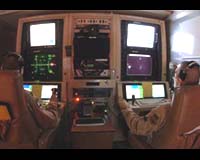
Moving silently high in the sky, Balad AB's MQ-1 Predator Unmanned Aerial Vehicles patrol the landscape below scaning for any signs of insurgent activity around Iraq. Back on the ground tucked away in a dark room full of computer monitors, TV screens, keyboards and joysticks, members of the 46th Expeditionary Reconnaissance Squadron monitor the images sent down by the bird above.
"The Predator is pretty much a glider with a power motor," said Maj. Craig Babbitt, 46th ERS commander. "The difference is it's got precision strike capabilities and can tell our guys on the ground or in the air right where the bad guys are."
Less than a dozen Airmen make up the 46th ERS. They are responsible for the takeoff and landing of Balad AB's fleet of Predators. Every sortie is manned on the ground by a pilot, who flies the aircraft and controls the weapons system by remote control. A sensor operator controls the camera view and laser targeting system on the aircraft.
Once the Predator is in the air, the pilot and sensor operator will locate a target point used to zero in the weapons system. The sensor operator works with an Airman on the ground to ensure the laser, which guides the Predator's weapons system, is on target.
When the weapons system has been zeroed in, the pilot prepares to hand off control of the UAV to people stationed halfway around the world at Nellis Air Force Base, Nev. The Predator pilots at Balad AB physically operate the aircraft within an approximate 25-mile radius of the base, and the pilots at Nellis AFB control it at further distances.
The ability to operate the Predator in Iraq and Afghanistan from a computer in the United States is one of its major benefits, said Major Babbitt.
"About the only thing we can't do from home is takeoff and land due to about a 6-second satellite delay," he said. "Because of that, less people need to be deployed, and less people are put in danger."
There are disadvantages to the Predator, such as a limited field of view, the inability to hear the aircraft to get an idea of potential problems, and the infrared light of the Predator's camera can be ineffective in rain and other adverse weather conditions, the major said. However, the advantages far outweigh the disadvantages.
"Very rarely will all of our birds be on the ground at the same time," Major Babbitt said. "We are basically non-stop operations. The Predator's intelligence surveillance provides us with live-feed data that we pass on to the war fighter both in the air and on the ground. "We're able to monitor the enemy while minimizing the pilot's time in the air."
The Predator is also protecting the lives of servicemembers stationed at Balad AB and traveling in convoys throughout Iraq. When identifying potential improvised explosive devices on the road, the Predator can alert convoys of dangers ahead. When recognizing the source of mortar attacks, the Predator can pinpoint the location of those responsible so the quick-reaction forces can apprehend the suspects and prevent further attacks on coalition forces.
Most of the time, the Predator is just up there watching and compiling information.
"We just watch for inconsistencies," the major said. "We're there to watch, and we can watch all day long, all night long. We're usually involved in the fight in one way or another. We might not always know exactly what we're looking for, but we know we're contributing to the success of the mission."