
 |
 |
 |
 |
 |
 |
 |
 |
 |
 |

| . |  |
. |

Huntsville AL (SPX) Oct 06, 2010 G327.1-1.1 is the aftermath of a massive star that exploded as a supernova in the Milky Way galaxy. A highly magnetic, rapidly spinning neutron star called a pulsar was left behind after the explosion and is producing a wind of relativistic particles, seen in X-rays by Chandra and XMM-Newton (blue) as well as in the radio data (red and yellow). This structure is called a pulsar wind nebula. The likely location of the spinning neutron star is shown in the labeled version. The large red circle shows radio emission from the blast wave, and the composite image also contains infrared data from the 2MASS survey (red, green, and blue) that show the stars in the field. No clear explanation is yet known for the unusual nature of G327.1-1.1, including the off-center position of the pulsar wind nebula seen in the radio data and the comet-like shape of the X-ray emission. One possibility is that we are seeing the effects of a shock wave bouncing backwards off of the shell of material - or envelope - swept up by the blast wave produced by the explosion, the so-called "reverse shock" from the blast wave. The pulsar is moving upwards, away from the center of the explosion, but the pulsar wind nebula is being swept towards the bottom-left of the image by the reverse shock wave that is also traveling towards the bottom-left. The direction of the pulsar's motion and of the reverse shock are shown in the labeled version. The X-ray observations allow scientists to estimate the energy released during the supernova explosion and the age of the remnant, as well as the amount of material being swept up as the blast wave from the explosion expands. The faint bubble that the pulsar appears to be creating may also be revealing the fresh pulsar wind being blown into the region cleared out by the reverse shock. A paper describing these results appeared in The Astrophysical Journal in February 2009 with Tea Temim of the Harvard-Smithsonian Center for Astrophysics (CfA), Patrick Slane (CfA), Bryan Gaensler (University of Sydney), Jack Hughes (Rutgers) and Eric Van Der Swaluw (Royal Netherlands Meterological Institute) as authors.
Share This Article With Planet Earth
Related Links Chandra at Marshall Stellar Chemistry, The Universe And All Within It

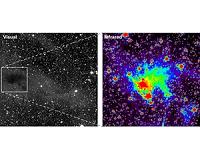 Coreshine Provides Insight Into Stellar Births
Heidelberg, Germany (SPX) Sep 24, 2010 Stars are formed as the dense core regions of cosmic clouds of gas and dust ("molecular clouds") collapse under their own gravity. As a result, matter in these regions becomes ever denser and hotter until, finally, nuclear fusion is ignited: a star is born. This is how our own star, the Sun, came into being; the fusion processes are responsible for the Sun's light, on which life on Earth depends ... read more |
|
|
| The content herein, unless otherwise known to be public domain, are Copyright 1995-2010 - SpaceDaily. AFP and UPI Wire Stories are copyright Agence France-Presse and United Press International. ESA Portal Reports are copyright European Space Agency. All NASA sourced material is public domain. Additional copyrights may apply in whole or part to other bona fide parties. Advertising does not imply endorsement,agreement or approval of any opinions, statements or information provided by SpaceDaily on any Web page published or hosted by SpaceDaily. Privacy Statement |


 del.icio.us
 Digg
Digg Reddit
 YahooMyWeb
 Google
 Facebook


