
 |
 |
 |
 |
 |
 |
 |
 |
 |
 |

| . |  |
. |

Boston MA (SPX) Dec 15, 2010 In an exciting example of international collaboration, a Qatar astronomer teamed with scientists at the Harvard-Smithsonian Center for Astrophysics (CfA) and other institutions to discover a new alien world. This "hot Jupiter," now named Qatar-1b, adds to the growing list of alien planets orbiting distant stars. Its discovery demonstrates the power of science to cross political boundaries and increase ties between nations. "The discovery of Qatar-1b is a great achievement - one that further demonstrates Qatar's commitment to becoming a leader in innovative science and research," said Dr. Khalid Al Subai, leader of the Qatar exoplanet survey and a research director of the Qatar Foundation for Education, Science and Community Development. "This discovery marks the beginning of a new era of collaborative astrophysics research between Qatar, the United Kingdom, and the United States," he added. The Qatar exoplanet survey hunts for stars that "wink," dimming slightly every time an orbiting planet creates a "mini-eclipse" by crossing in front of the star as seen from Earth. Transit searches like this must sift through thousands of stars to find the small fraction with detectable planets. The complex observations and analysis create perfect opportunities for teamwork. "The discovery of Qatar-1b is a wonderful example of how science and modern communications can erase international borders and time zones. No one owns the stars. We can all be inspired by the discovery of distant worlds," said CfA team member David Latham. To find the new world, Qatar's wide-angle cameras (located in New Mexico) took images of the sky every clear night beginning in early 2010. The photographs then were transmitted to the UK for analysis by collaborating astronomers at St. Andrews and Leicester Universities and Qatar. That analysis narrowed the field to a few hundred candidate stars. The Harvard-Smithsonian team, with Dr. Al Subai, followed up on the most promising candidates, making spectroscopic observations with the 60-inch-diameter telescope at the Smithsonian's Whipple Observatory in Arizona. Such observations can weed out binary-star systems with grazing eclipses, which mimic planetary transits. They also measured the stars' dimming more accurately with Whipple's 48-inch telescope. The resulting data confirmed the existence of a planet now called Qatar-1b, orbiting an orange Type K star 550 light-years away. Qatar-1b is a gas giant 20 percent larger than Jupiter in diameter and 10 percent more massive. It belongs to the "hot Jupiter" family because it orbits 2.2 million miles from its star - only six stellar radii away. The planet roasts at a temperature of around 2,000 degrees Fahrenheit. Qatar-1b circles its star once every 1.4 days, meaning that its "year" is just 34 hours long. It's expected to be tidally locked with the star, so one side of the planet always faces the star. As a result, the planet spins on its axis once every 34 hours - three times slower than Jupiter, which rotates once in 10 hours.
Share This Article With Planet Earth
Related Links Harvard-Smithsonian Center for Astrophysics Lands Beyond Beyond - extra solar planets - news and science Life Beyond Earth

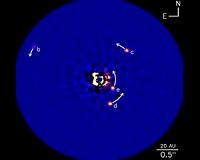 Planetary Family Portrait Reveals Another Exoplanet
Victoria, Canada (SPX) Dec 15, 2010 An international team of astronomers has discovered a fourth giant planet, HR 8799e, outside our solar system. The new planet joins the three planets that were the subjects of the first-ever images of a planetary family orbiting a star other than our Sun. The planets orbit the star HR 8799, which lies about 129 light years from Earth and is faintly visible to the naked eye. All four planet ... read more |
|
|
| The content herein, unless otherwise known to be public domain, are Copyright 1995-2010 - SpaceDaily. AFP and UPI Wire Stories are copyright Agence France-Presse and United Press International. ESA Portal Reports are copyright European Space Agency. All NASA sourced material is public domain. Additional copyrights may apply in whole or part to other bona fide parties. Advertising does not imply endorsement,agreement or approval of any opinions, statements or information provided by SpaceDaily on any Web page published or hosted by SpaceDaily. Privacy Statement |


 del.icio.us
 Digg
Digg Reddit
 YahooMyWeb
 Google
 Facebook


