
. Military Space News .
TIME AND SPACE
Rotating galaxies galore in the infant universe
by Staff Writers
Pasadena CA (SPX) Apr 22, 2020

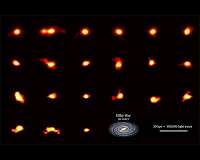
A collage of 21 galaxies imaged by the ALPINE survey. The images are based on light emitted by singly ionized carbon, or C+. These data show the variety of different galaxy structures already in place less than 1.5 billion years after the Big Bang (our universe is 13.8 billion years old). Some of the images actually contain merging galaxies; for example, the object in the top row, second from left, is actually three galaxies that are merging. Other galaxies appear to be more smoothly ordered and may be spirals; a clear example is in the second row, first galaxy from the left. Our Milky Way galaxy is shown to scale to help visualize the small sizes of these infant galaxies. Credit: Michele Ginolfi (ALPINE collaboration); ALMA(ESO/NAOJ/NRAO); NASA/JPL-Caltech/R. Hurt (IPAC)

New results from an ambitious sky survey program, called ALPINE, reveal that rotating disk-shaped galaxies may have existed in large numbers earlier in the universe than previously thought.

The ALPINE program, formally named "ALMA Large Program to Investigate C+ at Early Times," uses data obtained from 70 hours of sky observations with the ALMA observatory (Atacama Large Millimeter/submillimeter Array) in Chile, in combination with data from previous observations by a host of other telescopes, including the W. M. Keck Observatory in Hawaii and NASA's Hubble and Spitzer space telescopes. Specifically, the survey looked at a patch of sky containing dozens of remote galaxies.

"This is the first multi-wavelength study from ultraviolet to radio waves of distant galaxies that existed between 1 billion and 1.5 billion years after the Big Bang," says Andreas Faisst, a staff scientist at IPAC, an astronomy center at Caltech, and a principal investigator of the ALPINE program, which includes scientists across the globe.

One of ALPINE's key functions is using ALMA to observe the signature of an ion known as C+, which is a positively charged form of carbon. When ultraviolet light from newborn stars hits clouds of dust, it creates the C+ atoms.

By measuring the signature of this atom, or "emission line," in galaxies, astronomers can see how the galaxies are rotating; as the gas containing C+ in the galaxies spins toward us, its light signature shifts to bluer wavelengths, and as it spins away, the light shifts to redder wavelengths. This is similar to a police car's siren increasing in pitch as it races toward you and decreasing as it moves away.

The ALPINE team made the C+ measurements on 118 remote galaxies to create a catalog of not only their rotation speeds but also other features such as gas density and the number of stars that are formed.

The survey revealed rotating mangled galaxies that were in the process of merging, in addition to seemingly perfectly smooth spiral-shaped galaxies. About 15 percent of the galaxies observed had a smooth, ordered rotation that is expected for spiral galaxies. However, the authors note, the galaxies may not be spirals but rotating disks with clumps of material. Future observations with the next generation of space-based telescopes will pinpoint the detailed structure of these galaxies.

"We are finding nicely ordered rotating galaxies at this very early and quite turbulent stage of our universe," says Faisst. "That means they must have formed by a smooth process of gathering gas and haven't collided with other galaxies yet, as many of the other galaxies have."

By combining the ALMA data with measurements from other telescopes, including the now-retired Spitzer, which specifically helped measure the masses of the galaxies, the scientists are better able to study how these young galaxies evolve over time.

"How do galaxies grow so much so fast? What are the internal processes that let them grow so quickly? These are questions that ALPINE is helping us answer," says Faisst. "And with the upcoming launch of NASA's James Webb Space Telescope, we will be able to follow-up on these galaxies to learn even more."

Research Report: "The ALPINE-ALMA [CII] Survey: Multi-Wavelength Ancillary Data and Basic Physical Measurements"


Related Links
Caltech
Understanding Time and Space


Thanks for being here;
We need your help. The Space Media Network continues to grow but revenues have never been harder to maintain.

With the rise of Ad Blockers, and Facebook - our traditional revenue sources via quality network advertising continues to decline. And unlike so many other news sites, we don't have a paywall - with those annoying usernames and passwords.

Our news coverage takes time and effort to publish 365 days a year.

If you find our news sites informative and useful then please consider becoming a regular supporter or for now make a one off contribution.
SpaceMediaNetwork Contributor
$5 Billed Once


credit card or paypal
SpaceMediaNetwork Monthly Supporter
$5 Billed Monthly


paypal only


TIME AND SPACE
T2K insight into the origin of the universe
Lancaster UK (SPX) Apr 16, 2020
Lancaster physicists working on the T2K major international experiment in Japan are closing in on the mystery of why there is so much matter in the Universe, and so little antimatter. The Big Bang should have created equal amounts of matter and antimatter in the early Universe but instead the Universe is made of matter. One of the greatest challenges in physics is to determine what happened to the antimatter, or why we see an asymmetry between matter and antimatter. Tokai to Kamioka (T2K) re ... read more

Comment using your Disqus, Facebook, Google or Twitter login.


Share this article via these popular social media networks
del.icio.usdel.icio.us DiggDigg RedditReddit GoogleGoogle

TIME AND SPACE
Russia positions S-500 as game changer for missile defense

Iran warns US after Patriot deployment to Iraq

US deploys Patriot air defence system to Iraq

Lockheed awarded $932.8M to make THAADs for U.S., Saudi Arabia

TIME AND SPACE
Northrop Grumman's Advanced Anti-Radiation Guided Missile continues to protect the US Navy

Lockheed nabs $147.6M for MK41 components

US Norway to partner on hypersonic missile propulsion systems

Air Force selects Raytheon for Long-Range Standoff missile development

TIME AND SPACE
High value targets found in minutes versus days during Wake-Cho Feasibility Study

American Manufacturers Swift Tactical Systems and Silvus Technologies Announce Strategic Alliance

Steering drones for power generation

Citadel Defense Launches New AI and Machine Learning Software to Detect and Defeat Air, Land, and Sea Drones

TIME AND SPACE
US Space Force awards L3Harris Technologies $500 Million IDIQ contract for anti-jam satellite modem

US Space Force pens $1B in contracts for unjammable modems

AEHF-6 Satellite Actively Communicating With U.S. Space Force

AEHF-6 satellite completes protected satellite constellation

TIME AND SPACE
Future Army vehicles could see an improvement in structural materials

New stop-movement order will allow some soldiers to change station

Is it time for a 'new way of war?' What China's army reforms mean for the rest of the world

Amid COVID-19 hurdles, AFRL develops "jump kits" to rapidly enable operations

TIME AND SPACE
DoD expects three-month delays in military equipment deliveries

NATO needs to protect strategic industries: Stoltenberg

Coronavirus challenges US military machine

DoD urges defense contractors, subcontractors to stay at work

TIME AND SPACE
Trump warns China could face 'consequences' over pandemic

Beijing names islands in disputed South China Sea

Russia intercepts another U.S. Navy plane over Mediterranean Sea

As US pulls back, China builds influence at UN

TIME AND SPACE
Magnetic nanoparticles help researchers remotely release adrenal hormones

New DNA origami motor breaks speed record for nano machines

Deep-sea osmolyte makes biomolecular machines heat-tolerant


The content herein, unless otherwise known to be public domain, are Copyright 1995-2024 - Space Media Network. All websites are published in Australia and are solely subject to Australian law and governed by Fair Use principals for news reporting and research purposes. AFP, UPI and IANS news wire stories are copyright Agence France-Presse, United Press International and Indo-Asia News Service. ESA news reports are copyright European Space Agency. All NASA sourced material is public domain. Additional copyrights may apply in whole or part to other bona fide parties. All articles labeled "by Staff Writers" include reports supplied to Space Media Network by industry news wires, PR agencies, corporate press officers and the like. Such articles are individually curated and edited by Space Media Network staff on the basis of the report's information value to our industry and professional readership. Advertising does not imply endorsement, agreement or approval of any opinions, statements or information provided by Space Media Network on any Web page published or hosted by Space Media Network. General Data Protection Regulation (GDPR) Statement Our advertisers use various cookies and the like to deliver the best ad banner available at one time. All network advertising suppliers have GDPR policies (Legitimate Interest) that conform with EU regulations for data collection. By using our websites you consent to cookie based advertising. If you do not agree with this then you must stop using the websites from May 25, 2018. Privacy Statement. Additional information can be found here at About Us.