|
 |
 |
 |
 |
 |
 |
 |

| . |  |
. |

|
|
. |

 by Staff Writers Moscow (AFP) Aug 3, 2011
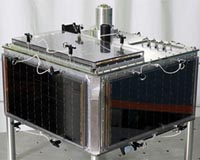
Two Russian cosmonauts on Wednesday embarked on a six-hour space walk from the International Space Station that ran into immediate problems when they aborted a bid to launch a mini-satellite in honour of Yuri Gagarin. Television pictures from space showed Sergei Volkov and Alexander Samokutyaev -- wearing Russian Orlan-K space suits that resembled large refrigerators -- open the hatch 20 minutes behind schedule at 1450 GMT. The two men then spent about 30 minutes tethering themselves into place before taking their first tentative steps into space with the micro-satellite in hand. The Kedr (Ceder) craft earned its name from the call letters the world's first space traveller used on his pioneering voyage on April 12, 1961. The little craft was designed by Russian engineers and was supposed to carry out student experiments and emit greetings in 17 languages. But the US space agency NASA and Russian officials said the satellite for some reason only managed to deploy one of its two antennas once it was pushed into space. "We are turning off the starter switches and going back in," a Russian space official announced during the live space flight broadcast. A NASA official said the satellite may yet be launched later in the day after a round of urgent consultations and Russian officials said they were also expecting to launch the vessel on the second attempt. "We have decided to launch the satellite with one antenna," a Russian mission control official was quoted as saying by Interfax. The bizarre incident began when someone from Russian mission control noticed that the simple satellite only had only one of its two antennas sticking out and asked why. Cosmonaut Samokutyaev replied that he did not know and that the Kedr appeared to have come equipped that way. "I came here three months before Sergei (Volkov) and it was already just the one antenna," he was quoted as saying by Interfax. The satellite's developer later told Russian reporters that the missing antenna was actually folded inside the Kedr for safekeeping during its transport to space. "There is no one to blame here," Kedr developer Sergei Samburov told the RIA Novosti news agency. "The cosmonauts will try to catch the (folded) antenna by the pinkies of their gloves and pull it out," the satellite developer said. The mission would not be considered a complete failure if the mini-satellite sage does not live to see a happy ending. The two men will also take photographs of portraits of Gagarin and the father of the Soviet space programme Sergei Korolyev against the backdrop of the earth in a highly symbolic gesture likely to get broad play in Russia. The pair is also expected to move a cargo boom from one airlock to another and install a prototype laser communications system.
|
. |
|
| The content herein, unless otherwise known to be public domain, are Copyright 1995-2011 - Space Media Network. AFP and UPI Wire Stories are copyright Agence France-Presse and United Press International. ESA Portal Reports are copyright European Space Agency. All NASA sourced material is public domain. Additional copyrights may apply in whole or part to other bona fide parties. Advertising does not imply endorsement,agreement or approval of any opinions, statements or information provided by Space Media Network on any Web page published or hosted by Space Media Network. Privacy Statement |

 del.icio.us
 Digg
Digg Reddit
 Google