
. Military Space News .
TIME AND SPACE
Scientists make step towards understanding the universe
by Staff Writers
Sheffield UK (SPX) Apr 17, 2020

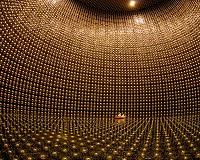
Neutrino detector at the T2K experiment.

Physicists from the University of Sheffield have taken a step towards understanding why the universe is made of mostly matter and not antimatter, by studying the difference between the two.

Findings from the T2K experiment, a large international collaboration of more than 350 scientists including a team from Sheffield, indicate a difference between the fundamental behaviour of elusive elementary particles, neutrinos, and of antineutrinos - their antimatter counterparts.

The research, published in Nature, is a major step forward in the study of the difference between matter and antimatter and could help to further our understanding of why the universe is mostly made up of matter and not equal parts of matter and antimatter.

The T2K Collaboration used the SuperKamiokande detector to observe neutrinos and antineutrinos which were generated 295km away at the Japanese Proton Accelerator Research Complex (J-PARC).

As they travel through the Earth, these particles oscillate between different physical properties known as flavours. The T2K collaboration found a mismatch in the way neutrinos and antineutrinos oscillate by recording the numbers that reached SuperKamiokande with a flavour different from the one they had been created with.

The observation of the difference in behaviour between neutrinos and antineutrinos is due to a so-called asymmetry in their physical properties. Measuring this asymmetry, known as charge-conjugation and parity reversal (CP) violation, may help us understand the origin of the current prevalence of matter over antimatter in the Universe.

Professor Lee Thompson, from the University of Sheffield's Department of Physics and Astronomy, said: "Astronomers find that the matter in the universe is overwhelmingly just that: matter, with positively charged atomic nuclei surrounded by negative electrons.

"When particle physicists make new particles in accelerators, they always find that they produce particle-antiparticle pairs: for every negative electron, a positively charged positron. So why isn't the universe 50 per cent antimatter? This is a long-standing problem in cosmology - what happened to the antimatter?

"This work brings together particle physics and cosmology - by studying neutrinos, the most elusive of the elementary particles, we learn something about the largest of astrophysical topics, the universe itself."

Professor Lee Thompson, Dr Susan Cartwright and Dr Matthew Malek from the University of Sheffield's Department of Physics and Astronomy made up the team from Sheffield.

The measurements found during the experiment strengthen previous observations and pave the way towards future discoveries. A new generation of experiments under construction, involving a team of particle physicists at Sheffield, might provide an answer to the problem of the missing antimatter in the next 10 years.

Research paper


Related Links
University of Sheffield
Understanding Time and Space


Thanks for being here;
We need your help. The Space Media Network continues to grow but revenues have never been harder to maintain.

With the rise of Ad Blockers, and Facebook - our traditional revenue sources via quality network advertising continues to decline. And unlike so many other news sites, we don't have a paywall - with those annoying usernames and passwords.

Our news coverage takes time and effort to publish 365 days a year.

If you find our news sites informative and useful then please consider becoming a regular supporter or for now make a one off contribution.
SpaceMediaNetwork Contributor
$5 Billed Once


credit card or paypal
SpaceMediaNetwork Monthly Supporter
$5 Billed Monthly


paypal only


TIME AND SPACE
T2K insight into the origin of the universe
Lancaster UK (SPX) Apr 16, 2020
Lancaster physicists working on the T2K major international experiment in Japan are closing in on the mystery of why there is so much matter in the Universe, and so little antimatter. The Big Bang should have created equal amounts of matter and antimatter in the early Universe but instead the Universe is made of matter. One of the greatest challenges in physics is to determine what happened to the antimatter, or why we see an asymmetry between matter and antimatter. Tokai to Kamioka (T2K) re ... read more

Comment using your Disqus, Facebook, Google or Twitter login.


Share this article via these popular social media networks
del.icio.usdel.icio.us DiggDigg RedditReddit GoogleGoogle

TIME AND SPACE
Russia positions S-500 as game changer for missile defense

Iran warns US after Patriot deployment to Iraq

US deploys Patriot air defence system to Iraq

Lockheed awarded $932.8M to make THAADs for U.S., Saudi Arabia

TIME AND SPACE
Russia ready to talk hypersonic weapons with US

General Dynamics nabs $55.9M to make missile tubes for U.S., Britain

Lockheed nabs $818.2M to produce JASSMs for Air Force, allies

Raytheon awarded $641.3M for work on Tomahawks for Navy

TIME AND SPACE
Observing the atmosphere at high altitudes using unmanned aerial vehicles

Sky Sapience introduces tethered UAV platform HoverMast

AFRL gives warfighters new weapons system

Boeing nabs $84.7M to build 3 more MQ-25s for Navy

TIME AND SPACE
US Space Force pens $1B in contracts for unjammable modems

AEHF-6 Satellite Actively Communicating With U.S. Space Force

AEHF-6 satellite completes protected satellite constellation

Sixth Advanced Extremely High Frequency satellite ready for launch

TIME AND SPACE
Future Army vehicles could see an improvement in structural materials

Underminer demos feasibility of rapidly constructed logistics tunnels

AFRL creates safer-than-steel synthetic winch cable for cargo aircraft

Amid COVID-19 hurdles, AFRL develops "jump kits" to rapidly enable operations

TIME AND SPACE
NATO needs to protect strategic industries: Stoltenberg

Coronavirus challenges US military machine

DoD urges defense contractors, subcontractors to stay at work

Lockheed Martin names new CEO

TIME AND SPACE
Russian veterans urge Putin to postpone WWII parade over virus

Trump freezes WHO funds as world weighs easing lockdown

US, China call for cooperation as virus tensions renew

China denies seeking virus praise from Germany

TIME AND SPACE
Magnetic nanoparticles help researchers remotely release adrenal hormones

New DNA origami motor breaks speed record for nano machines

Deep-sea osmolyte makes biomolecular machines heat-tolerant


The content herein, unless otherwise known to be public domain, are Copyright 1995-2024 - Space Media Network. All websites are published in Australia and are solely subject to Australian law and governed by Fair Use principals for news reporting and research purposes. AFP, UPI and IANS news wire stories are copyright Agence France-Presse, United Press International and Indo-Asia News Service. ESA news reports are copyright European Space Agency. All NASA sourced material is public domain. Additional copyrights may apply in whole or part to other bona fide parties. All articles labeled "by Staff Writers" include reports supplied to Space Media Network by industry news wires, PR agencies, corporate press officers and the like. Such articles are individually curated and edited by Space Media Network staff on the basis of the report's information value to our industry and professional readership. Advertising does not imply endorsement, agreement or approval of any opinions, statements or information provided by Space Media Network on any Web page published or hosted by Space Media Network. General Data Protection Regulation (GDPR) Statement Our advertisers use various cookies and the like to deliver the best ad banner available at one time. All network advertising suppliers have GDPR policies (Legitimate Interest) that conform with EU regulations for data collection. By using our websites you consent to cookie based advertising. If you do not agree with this then you must stop using the websites from May 25, 2018. Privacy Statement. Additional information can be found here at About Us.