
 |
 |
 |
 |
 |
 |
 |
 |
 |
 |

| . |  |
. |
Spectratime Awarded Contract To Supply Rubidium Space Clocks To IRNSS
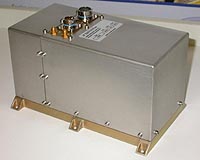
Neuchatel, Switzerland (SPX) Sep 16, 2008 SpectraTime has announced the award of a contract valued at approximately EUR 4 million to supply Rubidium Space Clocks to the Indian Regional Navigational Satellite System (IRNSS). With this new contract, SpectraTime confirms its position as the world-leading supplier of space atomic clocks and is on the way to having the largest number of atomic clocks in space on-board satellites. The Indian Regional Navigational Satellite System(IRNSS), developed by the Indian Space Agency ISRO, will consist of seven satellites. Three of the satellites will be placed in geostationary orbit and the four others in geosynchronous orbit. The constellation will also comprise a ground segment consisting of a Center of Principal Control and ground stations in order to follow the satellites and to guarantee the system integrity. The Indian Regional Navigational Satellite System, whose first satellite could be launched in 2009, will be able to provide an absolute position with an accuracy of 20 meters through all India and at a distance of about 2000 km beyond its borders.
SpectraTime atomic clocks: the heart of the system The extremely precise measurement of time on board each satellite, achieved through embarked atomic clocks, is thus a central condition for the positioning performance of the system. In the framework of the IRNSS program, each satellite will have four SpectraTime Rubidium atomic clocks on board to reach a stability of less than 10 billionths of a second per day. "To give a point of comparison, our clocks are 10 million times more precise than a watch made of quartz," says Pascal Rochat, Chief Executive Officer of SpectraTime.
SpectraTime: the leading space atomic clocks supplier "A worldwide satellite navigation constellation consists of 20 to 30 satellites, embarking each three to four atomic clocks. Within five years, we expect to have the largest number of space-borne atomic clocks than any other company," says Rochat. Community Email This Article Comment On This Article Share This Article With Planet Earth
Related Links SpectraTime Understanding Time and Space
 NIST Quantum Logic Clock Rivals Mercury Ion As Most Accurate Clock Ever
 Boulder CO (SPX) Mar 07, 2008
An atomic clock that uses an aluminum atom to apply the logic of computers to the peculiarities of the quantum world now rivals the world's most accurate clock, based on a single mercury atom. Both clocks are at least 10 times more accurate than the current U.S. time standard. The measurements were made in a yearlong comparison of the two next-generation clocks, both designed and built at the Commerce Department's National Institute of Standards and Technology (NIST). |
|
|

| The content herein, unless otherwise known to be public domain, are Copyright 1995-2007 - SpaceDaily.AFP and UPI Wire Stories are copyright Agence France-Presse and United Press International. ESA Portal Reports are copyright European Space Agency. All NASA sourced material is public domain. Additional copyrights may apply in whole or part to other bona fide parties. Advertising does not imply endorsement,agreement or approval of any opinions, statements or information provided by SpaceDaily on any Web page published or hosted by SpaceDaily. Privacy Statement |
 del.icio.us
 Digg
Digg Reddit
 YahooMyWeb
 Google
 Facebook