
. Military Space News .
STELLAR CHEMISTRY
Star clusters discovery could upset the astronomical applecart
by Staff Writers
Perth, Australia (SPX) Mar 07, 2017


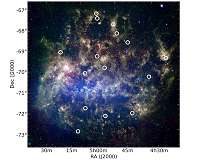
This vibrant image from NASA's Spitzer Space Telescope shows the Large Magellanic Cloud, a satellite galaxy to our own Milky Way galaxy. Image courtesy NASA/JPL-Caltech/M. Meixner (STScI) and the SAGE Legacy Team.

The discovery of young stars in old star clusters could send scientists back to the drawing board for one of the Universe's most common objects. Dr Bi-Qing For, from the International Centre for Radio Astronomy Research in Perth, said our understanding of how stars evolve is a cornerstone of astronomical science.

"There are a billion trillion stars in the Universe and we've been observing and classifying those we can see for more than a century," she said. "Our models of stellar evolution are based on the assumption that stars within star clusters formed from the same material at roughly the same time."

A star cluster is a group of stars that share a common origin and are held together by gravity for some length of time. Because star clusters are assumed to contain stars of similar age and composition researchers have used them as an "astronomical laboratory" to understand how mass affects the evolution of stars.

"If this assumption turns out to be incorrect, as our findings suggest, then these important models will need to be revisited and revised," Dr For said.

The discovery, published this week in the Monthly Notices of the Royal Astronomical Society, involves a study of star clusters located in the Large Magellanic Cloud, a neighbouring galaxy to the Milky Way. By cross-matching the locations of several thousand young stars with the locations of stellar clusters, the researchers found 15 stellar candidates that were much younger than other stars within the same cluster.

"The formation of these younger stars could have been fuelled by gas entering the clusters from interstellar space," said co-author Dr Kenji Bekki, also from the International Centre for Radio Astronomy Research. "But we eliminated this possibility using observations made by radio telescopes to show that there was no correlation between interstellar hydrogen gas and the location of the clusters we were studying.

"We believe the younger stars have actually been created out of the matter ejected from older stars as they die, which would mean we have discovered multiple generations of stars belonging to the same cluster."

Dr Bekki said the stars were currently too faint to see using optical telescopes because of the dust that surrounds them.

"They have been observed using infrared wavelengths by orbiting space telescopes Spitzer and Herschel, operated by NASA and the European Space Agency," he said.

"An envelope of gas and dust surrounds these young stars but as they become more massive and this shroud blows away, they will become visible at optical wavelengths for powerful instruments like the Hubble Space Telescope."

"If we point Hubble at the clusters we've been studying, we should be able to see both young and old stars and confirm once and for all that star clusters can contain several generations of stars."

'A discovery of young stellar objects in older clusters of the Large Magellanic Cloud', in the Monthly Notices of the Royal Astronomical Society published by Oxford University Press on 7 March 2017.

STELLAR CHEMISTRY
Revealing the origin and nature of the outskirts of stellar megalopolises
Santa Cruz de Tenerife, Spain (SPX) Mar 07, 2017
Galaxies have dramatically grown in size since the early Universe, and elliptical galaxies, in particular, are the largest galaxies in both size and mass. What is the main driver behind the late growth of their outer parts was the question that motivated this study. With disc galaxies, like our Milky Way, it is fairly easy to identify their distinct parts: the central bulge, the disc with ... read more

Related Links
International Centre for Radio Astronomy Research
Stellar Chemistry, The Universe And All Within It


Thanks for being here;
We need your help. The Space Media Network continues to grow but revenues have never been harder to maintain.

With the rise of Ad Blockers, and Facebook - our traditional revenue sources via quality network advertising continues to decline. And unlike so many other news sites, we don't have a paywall - with those annoying usernames and passwords.

Our news coverage takes time and effort to publish 365 days a year.

If you find our news sites informative and useful then please consider becoming a regular supporter or for now make a one off contribution.
SpaceMediaNetwork Contributor
$5 Billed Once


credit card or paypal
SpaceMediaNetwork Monthly Supporter
$5 Billed Monthly


paypal only


Comment on this article using your Disqus, Facebook, Google or Twitter login.

Share this article via these popular social media networks
del.icio.usdel.icio.us DiggDigg RedditReddit GoogleGoogle

STELLAR CHEMISTRY
UN hopes for easing of tensions after Chinese anger over THAAD

China vows 'resolute' measures after THAAD deployment

India stages successful test of missile interceptor

Protesters sue to stop US missile system in S. Korea

STELLAR CHEMISTRY
U.S. Navy test fires surface to surface missile module

Russia denies US claims it has violated arms treaty

Brazilian army buys more SAAB missile defense systems

Lockheed Martin completes flight tests with updated JASSM

STELLAR CHEMISTRY
Kelvin Hughes launching counter-drone system

Leonardo subsidiary to buy laser technology company Daylight Solutions

Hughes to provide satellite communications for SkyGuardian drones

Drone Aviation Delivers Enhanced WASP Tactical Aerostat to DoD

STELLAR CHEMISTRY
Intelsat General becomes Airbus channel partner for military satellite communications

Rockwell Collins, Australian air force test WBHF communication system

Space aggressors jam AF, allies' systems

General Dynamics gets enterprise communications contract

STELLAR CHEMISTRY
Sierra Nevada to continue U.S. counter-IED support

European Defense Agency completes artillery accuracy project

Lockheed Martin introduces Paragon direct attack bomb

Orbital ATK production of artillery shell guidance kits tops 10,000

STELLAR CHEMISTRY
Trump to press Congress for defense spending boost

BAE Systems eyes defence spending by Trump

UAE signs over $5 bln in deals at arms fair

Pentagon chief says military running smoothly amid turbulent transition

STELLAR CHEMISTRY
Putin pardons woman jailed over 'treasonous' text message

China slams US election 'farce' in annual rights report

Chinese ships enter Philippine waters; Sri Lanka scales back China port

China defence spending to rise 7 percent

STELLAR CHEMISTRY
Small nanoparticles have surprisingly big effects on polymer nanocomposites

Phonon nanoengineering: Vibrations of nanoislands dissipate heat more effectively

Most complex nanoparticle crystal ever made by design

Nano 'sandwich' offers unique properties


The content herein, unless otherwise known to be public domain, are Copyright 1995-2024 - Space Media Network. All websites are published in Australia and are solely subject to Australian law and governed by Fair Use principals for news reporting and research purposes. AFP, UPI and IANS news wire stories are copyright Agence France-Presse, United Press International and Indo-Asia News Service. ESA news reports are copyright European Space Agency. All NASA sourced material is public domain. Additional copyrights may apply in whole or part to other bona fide parties. All articles labeled "by Staff Writers" include reports supplied to Space Media Network by industry news wires, PR agencies, corporate press officers and the like. Such articles are individually curated and edited by Space Media Network staff on the basis of the report's information value to our industry and professional readership. Advertising does not imply endorsement, agreement or approval of any opinions, statements or information provided by Space Media Network on any Web page published or hosted by Space Media Network. General Data Protection Regulation (GDPR) Statement Our advertisers use various cookies and the like to deliver the best ad banner available at one time. All network advertising suppliers have GDPR policies (Legitimate Interest) that conform with EU regulations for data collection. By using our websites you consent to cookie based advertising. If you do not agree with this then you must stop using the websites from May 25, 2018. Privacy Statement. Additional information can be found here at About Us.