
. Military Space News .
FARM NEWS
Strip tillage, rowcovers for organic cucurbit production
by Staff Writers
University Park PA (SPX) Jan 03, 2017


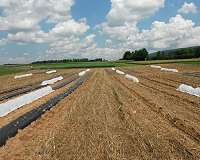
Photo of an experimental field at Penn State's Rock Springs Research Farm with newly transplanted 'Lioness' summer squash plants in both the strip tillage plots with drip irrigation (right) and plasticulture plots with drip irrigation (left). Each plot had treatments with and without row covers. Image courtesy of Jason Lilley. For a larger version of this image please go here.

Plasticulture systems, the use of polyethylene mulch on raised beds with drip irrigation, are common in the production of many cucurbit crops in the Northeastern US. Plasticulture systems have numerous benefits, but concerns about costs and the environmental impacts of plastic disposal, along with expenses related to system installation, are motivating scientists to find alternatives.

To determine the feasibility and effectiveness of alternative systems on cucurbit production, Pennsylvania State University researchers Jason Lilley and Elsa Sanchez, in collaboration with researchers from the University of Kentucky, Ohio State University, and Iowa State University, designed experiments to compare plasticulture and strip tillage systems with and without rowcovers in organically managed experiments.

Strip tillage systems, a form of conservation tillage in which cover crops or previous cash crop residue is left on the soil surface between rows while a narrow planting row is tilled, can reduce soil erosion, increase soil moisture retention and lead to increased soil microbial populations with less annual economic input than traditional systems.

In an article in the October 2016 issue of HortTechnology, Lilley and Sanchez share the results of two experiments in which they compared strip tillage to plasticulture systems for organically managed cucurbit crops.

In one experiment with 'Lioness' summer squash, and another experiment with 'Athena' muskmelon, plants grown in the strip tillage system had lower yields than in the plasticulture system in both years.

"Yield reductions observed in the strip tillage system in both years of the muskmelon experiment and in the first year of the summer squash experiment were beyond acceptable levels," said author Jason Lilley. "The need for specialized tillage equipment, delayed planting, and high weed pressure were all obstacles to the successful use of strip tillage in these experiments."

Rowcovers resulted in larger plants, but yields were comparable to not using rowcovers within the strip tillage and plasticulture systems. The use of rowcovers did allow for reduced insecticide applications.

Observations revealed a low incidence of bacterial wilt in both years of the experiments despite the presence of striped cucumber beetle populations above the set threshold throughout all experiments.

"This research demonstrates the difficulties of using a strip tillage production system for organic cucurbit production," Lilley and Sanchez noted.

Research paper


Comment on this article using your Disqus, Facebook, Google or Twitter login.


Thanks for being here;
We need your help. The Space Media Network continues to grow but revenues have never been harder to maintain.

With the rise of Ad Blockers, and Facebook - our traditional revenue sources via quality network advertising continues to decline. And unlike so many other news sites, we don't have a paywall - with those annoying usernames and passwords.

Our news coverage takes time and effort to publish 365 days a year.

If you find our news sites informative and useful then please consider becoming a regular supporter or for now make a one off contribution.
SpaceMediaNetwork Contributor
$5 Billed Once


credit card or paypal
SpaceMediaNetwork Monthly Supporter
$5 Billed Monthly


paypal only


.


Related Links
American Society for Horticultural Science
Farming Today - Suppliers and Technology


Share this article via these popular social media networks
del.icio.usdel.icio.us DiggDigg RedditReddit GoogleGoogle

Previous Report
FARM NEWS
Zambia drafts in air force to combat pests
Lusaka (AFP) Dec 29, 2016
Zambia has ordered the national air force into action to fight a plague of pests that has invaded maize crops and threatened vital food supplies. The air force is transporting pesticides across the country so that fields can be sprayed in an attempt to combat infestations of "army worms", a type of larvae moth that can decimate crops. "The Zambia Air Force has since begun to airlift chem ... read more


FARM NEWS
Lockheed Martin receives $1.4 billion for Patriot missile sales

U.S. Air Force approves Lockheed Martin's SBIRS ground system

Raytheon to provide Patriot missile capability for undisclosed country

Saudis intercept missile fired from Yemen

FARM NEWS
U.S. missile deal for Poland finalized

Successful flight test for Norwegian missile

U.S. Navy test fires Raytheon SM-6 missile at sea

Raytheon to perform additional SM-3 Block IIA missile work

FARM NEWS
Britain, France continue drone development project

Ford studies using drones to guide self-driving cars

Bird-like drone uses feathers for a more precise flight path

QinetiQ acquires Meggitt Target Systems

FARM NEWS
U.S. Navy selects Raytheon for tactical radio production

Underwater radio, anyone?

Japan to Launch First Military Communications Satellite on January 24

Intelsat General to provide satellite services to RiteNet for US Army network

FARM NEWS
Kongsberg contracted for M1A2 CROWS configuration

Raytheon offers InSITE for U.S. Army training program

BAE Systems to provide active protection for Dutch CV90 vehicles

Orbital ATK completes Zombie Pathfinder target test for U.S. Army

FARM NEWS
Saudi projects drop in defence spending

Trump calls on Boeing to offer quote for F-35 rival

NATO to procure U.S. munitions for members

Russia drops out of world's top 5 defense spenders

FARM NEWS
Top official urges independent Chinese Catholic Church

New UN chief wants to meet Trump 'as soon as possible'

India bans foreign funds of 20,000 charities: official

This is a drill: British army returns to Hong Kong

FARM NEWS
Nanoscale 'conversations' create complex, multi-layered structures

Going green with nanotechnology

Nanocubes simplify printing and imaging in color and infrared

New aspect of atom mimicry for nanotechnology applications


The content herein, unless otherwise known to be public domain, are Copyright 1995-2024 - Space Media Network. All websites are published in Australia and are solely subject to Australian law and governed by Fair Use principals for news reporting and research purposes. AFP, UPI and IANS news wire stories are copyright Agence France-Presse, United Press International and Indo-Asia News Service. ESA news reports are copyright European Space Agency. All NASA sourced material is public domain. Additional copyrights may apply in whole or part to other bona fide parties. All articles labeled "by Staff Writers" include reports supplied to Space Media Network by industry news wires, PR agencies, corporate press officers and the like. Such articles are individually curated and edited by Space Media Network staff on the basis of the report's information value to our industry and professional readership. Advertising does not imply endorsement, agreement or approval of any opinions, statements or information provided by Space Media Network on any Web page published or hosted by Space Media Network. General Data Protection Regulation (GDPR) Statement Our advertisers use various cookies and the like to deliver the best ad banner available at one time. All network advertising suppliers have GDPR policies (Legitimate Interest) that conform with EU regulations for data collection. By using our websites you consent to cookie based advertising. If you do not agree with this then you must stop using the websites from May 25, 2018. Privacy Statement. Additional information can be found here at About Us.