The number of stars in the Universe is staggering. Because there are billions of stars in each galaxy and there are billions of galaxies, the total number is hard to comprehend.
When astronomers at the Subaru Telescope think about this colossal number of stars, questions come to their minds that include, what is the population distribution of these stars in terms of the weight? How many stars are heavier or lighter than the Sun? What is the mass range of the stars formed in the Milky Way Galaxy?
These insightful questions reflect some of the most important issues in astronomy. The first step to answering these questions is to determine the initial mass distribution of stars, which is the number of stars versus their masses at the time of their formation; it is called the initial mass function (IMF). Since our galaxy contains stars of various ages, the observed mass distribution needs to be corrected to its initial value.
However, the star forming regions have an advantage, as a majority of the stars in these locations are formed at about the same time. In turn, there is no need to apply a complicated correction to the mass function in the case of sampling general stars in our Milky Way Galaxy.
The IMF has been estimated for the stars in our galactic neighborhood since around 1950. Recently, the IMF at the extremely low mass regime has become a hot topic. Brown dwarfs, objects with low masses (less than 0.08 solar masses [Msun]) that are too small to become normal stars, are very faint.
Thus, the IMF towards the mass range of brown dwarfs is still not clear. For example, in the case of several nearby star forming regions relative numbers of 0.5 Msun stars in comparison to 1.0 Msun star are reliably known, whereas the relative numbers of stars towards low mass end (masses less than 0.05 Msun) in comparison to 1 Msun star are still not well known.
Brown dwarfs do not burn hydrogen. Thus, as they age, they become too faint to detect easily. However, young brown dwarfs are relatively bright in the infrared wavelengths, due to their self-gravitational energy. Therefore, to study the IMF towards the mass range of brown dwarfs, astronomers perform infrared observations of star forming regions.
Previous observations are limited toward the nearest star forming regions, especially toward low-mass star forming regions such as Taurus and the nearest massive star forming region of Orion.
It is believed that majority of stars in our galaxy are formed in star clusters and the low mass stars within are a majority. As a result, previous observations have not provided the IMF of the stars representing the entire population of the galaxy.
Most star clusters containing massive stars are more than twice as distant as the Orion star-forming region (M42). Large telescopes, such as 8.2m Subaru, are necessary for observations of faint stars in these far off star-forming regions. Moreover, in the case of stars in a distant cluster, high resolution imaging is also needed to recognize individual stars.
In order to explore dim distant low mass stars, a team of Japanese and Indian astronomers used the high sensitivity and spatial resolution of the CISCO infrared camera at Subaru to obtain unprecedented detailed data toward the W3 Main star forming region.
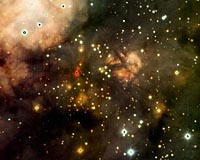
W3 Main, located approximately 6,000 light years away in the constellation Cassiopeia, is a very active and massive star-forming region. Figure 1, approximately 1.6 arc minutes across, shows the false-color infrared image of W3 Main based on Subaru data (red: K; green: H; blue: J).
To date, this near-infrared image is the deepest and finest image from a ground-based telescope among the images of massive star forming regions. Our deep and high-resolution image shows distinctive reddish and bluish nebulosity features, dark filaments between the diffuse nebulosities, and a significant population of faint stars in W3 Main.
The study has shown for the first time that there is a significant number of brown dwarfs in the W3 Main star forming region. This result is significantly different from that obtained in the cases of Trapezium and IC 348, where a decrease of relative population of brown dwarfs was found (see Figure 2).
The research findings indicate that a relative number of brown dwarfs may differ among regions in the galaxy. For the future, the team will proceed with the observations toward much more massive star forming regions in remote areas to study whether the results are widespread.
The results from this study will appear in of the Astrophysical Journal.
W3 Main Team Members:
Devendra Ojha (Associate Professor at TIFR, Mumbai, India)
Motohide Tamura (Associate Professor at NAOJ)
Yasushi Nakajima (Postdoctoral fellow at NAOJ)
Hiro Saito (Postdoctoral fellow at NAOJ)
Anil Pandey (Scientist at ARIES, Nainital, India)
Swarna Kanti Ghosh (Professor at TIFR, Mumbai, India)
Kentaro Aoki (Astronomer at NAOJ)
 del.icio.us
 Digg
Digg Reddit
 YahooMyWeb
 Google
 Facebook