|
 |
 |
 |
 |
 |
 |
 |
 |
 |

| . |  |
. |
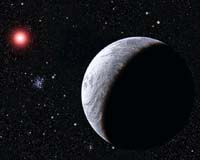
Super Snowballs
Cambridge, MA (SPX) Oct 16, 2006 The 200 known planets that orbit other stars exhibit incredible variety. Among them are a handful of worlds that weigh between 5 and 15 times Earth. Astronomers believe these "super-Earths" are rocky iceballs rather than gas giants like Jupiter. While theorists can explain how such worlds form around Sun-like stars, the discovery of super-Earths around tiny red dwarf stars was surprising. New research suggests that some super-Earths build up rapidly when local temperatures drop and ices condense out of the surrounding gas. "We believe that some super-Earths form during a cosmic 'snowstorm.' Only this snowstorm envelops the whole planet and lasts millions of years,'" said astronomer Scott Kenyon of the Smithsonian Astrophysical Observatory. All planets form within a disk of gas and dust surrounding a newborn star. Rocky planets form close to the star, where it is warm, while icy and gaseous planets form farther out, where it is cold. When it was young, the Sun was relatively stable, leading to a natural progression of small, rocky worlds in the hot inner solar system and large, gaseous worlds in the cold outer solar system. In contrast, planetary systems around small red dwarf stars undergo dramatic changes in their early history. As the young star evolves, it dims. The warm inner disk starts to freeze, creating conditions where water and other volatile gases condense into snowflakes and ice pellets. "It's like a massive cold front that sweeps inward toward the star," explained first author Grant Kennedy of Mount Stromlo Observatory in Australia. "The ices add mass to a growing planet, and also make it easier for particles to stick together. The two effects combine to produce a planet several times the size of Earth." The disks that surround small red dwarf stars tend to contain less material than the disk that formed the solar system. Without the "snowstorms" in these smaller disks, there is not enough material to make super-Earths. Although astronomers have discovered a few super-Earths orbiting red dwarf stars, it may be tough to find worlds hospitable to humans. All of the known super-Earths are icy worlds with no liquid water. Red dwarf stars are so dim and cool that their warm "habitable zones" are very close to the star, where there is very little planet-forming material. "It's difficult to make anything larger than Mercury or Mars in the habitable zone of a red dwarf," said Kenyon. The astronomers presented their calculations in a paper authored by Kennedy, Kenyon, and Benjamin Bromley (University of Utah). That paper has been accepted for publication in The Astrophysical Journal Letters. The team now plans to conduct detailed numerical simulations to derive typical timescales for the formation of super-Earths around red dwarf stars. Related Links Smithsonian Astrophysical Observatory Extrasolar Planets Stellar Chemistry, The Universe And All Within It  A Film Of The Heavens
 Heidelberg, Germany (SPX) Oct 13, 2006
Astronomers from the Max-Planck-Institutes for Astronomy in Heidelberg and for Extraterrestrial Physics in Garching have joined with colleagues world-wide to form a consortium that will exploit a powerful new survey telescope on Haleakala on the island of Maui (Hawaii). This telescope will map repeatedly much of the entire sky, hence creating a high color-map and the first digital "movie" of the heavens, mapping changes in the sky with time. |
|
|

| The content herein, unless otherwise known to be public domain, are Copyright 1995-2006 - SpaceDaily.AFP and UPI Wire Stories are copyright Agence France-Presse and United Press International. ESA PortalReports are copyright European Space Agency. All NASA sourced material is public domain. Additionalcopyrights may apply in whole or part to other bona fide parties. Advertising does not imply endorsement,agreement or approval of any opinions, statements or information provided by SpaceDaily on any Web page published or hosted by SpaceDaily. Privacy Statement |