
 |
 |
 |
 |
 |
 |
 |
 |
 |
 |

| . |  |
. |
TNO Star Separators Help ESO With Detection Of Exoplanets
Delft, Netherlands (SPX) Sep 19, 2008 The PRIMA facility with TNO's Star Separators was successfully tested during a "first light" test at the beginning of September. PRIMA will set a new benchmark in astrometry and will enable exoplanet detection with high precision astrometric measurements as well as imaging of faint objects. The European Southern Observatory (ESO) has built the PRIMA (Phase-Referenced Imaging and Microarcsecond Astrometry) facility on the Very Large Telescope Interferometer (VLTI) in Chile. TNO's Star Separators have been installed on two VLTI Auxiliary Telescopes.
Star Separator
Finding new planets It has a different detection bias, more suitable to planets in large orbits, similar to our own solar system. For successful exoplanet detection an astrometric accuracy of at least 10 microarcsec is needed, comparable to the ability to detect a Euro coin on the Moon from Earth. This is beyond the performance of the current space and ground based astronomical telescopes, including the Hubble Space Telescope.
How PRIMA works TNO was responsible for the development of the Star Separators. PRIMA allows simultaneous observation of two objects. One is a bright star in the field of view of the telescope and the other one the (faint) scientific object. The bright star is used to control the interferometry (fringe position). When the fringes of the bright star are stabilised, the fringes of the fainter science object can be studied. With PRIMA the global limiting magnitude of the VLTI will gain about four magnitudes. Science observations will start after the completion of a 6 months testing and characterisation phase. Community Email This Article Comment On This Article Share This Article With Planet Earth
Related Links TNO Lands Beyond Beyond - extra solar planets - news and science Life Beyond Earth
 First Picture Of Likely Planet Around Sun-Like Star
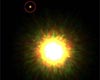 Toronto, Canada (SPX) Sep 17, 2008
Astronomers have unveiled what is likely the first picture of a planet around a normal star similar to the sun. Three University of Toronto scientists used the Gemini North telescope on Mauna Kea in Hawai'i to take images of the young star 1RXS J160929.1-210524 (which lies about 500 light-years from Earth) and a candidate companion of that star. |
|
|

| The content herein, unless otherwise known to be public domain, are Copyright 1995-2007 - SpaceDaily.AFP and UPI Wire Stories are copyright Agence France-Presse and United Press International. ESA Portal Reports are copyright European Space Agency. All NASA sourced material is public domain. Additional copyrights may apply in whole or part to other bona fide parties. Advertising does not imply endorsement,agreement or approval of any opinions, statements or information provided by SpaceDaily on any Web page published or hosted by SpaceDaily. Privacy Statement |
 del.icio.us
 Digg
Digg Reddit
 YahooMyWeb
 Google
 Facebook