
 |
 |
 |
 |
 |
 |
 |
 |
 |
 |

| . |  |
. |
The Case Of The Missing Gamma-Ray Bursts
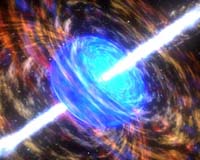
Science@NASA Huntsville AL (SPX) Oct 23, 2008 Gamma-ray bursts are by far the brightest and most powerful explosions in the Universe, second only to the Big Bang itself. So it might seem a bit surprising that a group of them has gone missing. A single gamma-ray burst (GRB) can easily outshine an entire galaxy containing hundreds of billions of stars. Powerful telescopes can see them from clear across the Universe. And because the deeper you look into space, the farther back in time you see, astronomers should be able to see GRBs from the time when the very first stars were forming after the Big Bang. Yet they don't. Gamma-ray bursts from that early epoch seem to be missing, and astronomers are wondering where they are. "This is one of the biggest questions in the gamma-ray business," says astrophysicist Neil Gehrels of the Goddard Space Flight Center. "It's something we're going to be talking a lot about today at the GRB Symposium." Gehrels has joined about a hundred of his colleagues from 25 countries for the 6th Huntsville Gamma-ray Burst Symposium underway this week in Huntsville, Alabama. Missing gamma-ray bursts are one of the top mysteries on the agenda. Until recently, experts were grappling with an even more fundamental question about GRBs: what the heck are they? Astronomers had observed these astonishing bursts since the 1960s, but nobody could imagine an event powerful enough to create them. The answer eventually came from Stan Woosley, a theoretical astrophysicist at the University of California in San Diego. He suggested that when young, supermassive stars with low metal content collapse under their own weight to form black holes, the stars' rotation funnels the explosive energy into two streamlined jets that shoot out from the stars' poles, like the axis of a gyro. We only see the burst if one of these two jets happens to be pointed toward Earth. The concentration of energy into narrow jets is why GRBs that we do observe appear so remarkably bright. Note: Woosley's"collapsar model" explains the common long gamma-ray burst, explosions lasting 2 seconds or more. The cause of another class of shorter-lived GRBs is still a mystery, but that's another story. The first waves of star formation after the Big Bang should have produced plenty of metal-poor supermassive stars ripe for collapse. If true, GRBs from that epoch should be abundant. So where are they? One possibility is they're not missing at all. "Part of the problem is that burst profiles get stretched out by the expansion of the Universe, so it is harder to recognize them as bursts in the first place," explains astrophysicist Lynn Cominsky of Sonoma State University. "The bursts could be happening, but we're not noticing them." Another trouble is the afterglow-the fading debris that tells so much about a burst, including its distance. "Afterglows from the most distant GRBs may be too red shifted to be seen by current generations of telescopes," she notes. "Red shift" is how much the wavelength of light is stretched when it travels to us across the expanding Universe. The farther away a thing is, the more its light is stretched, and the greater the red shift. Until recently, the largest red shift ever measured for a GRB was 6.3. Then, last month, Gehrels and colleagues using NASA's Swift satellite found one with a red shift of 6.7 or 12.8 billion light years away. So far, that's the record. "Gamma-ray bursts are predicted in the red shift range 10 to 20, but so far no one has seen anything beyond 6.7," says Cominsky. The luminous afterglow of such distant bursts would be red shifted all the way into the infrared. "There's a huge effort right now to try to get those infrared observations," Gehrels says, but in the meantime it's difficult to verify whether a candidate 7+ GRB is truly that far away. As infrared telescopes improve, scientists should eventually be able to measure the distance to GRBs with red shifts greater than 7 - if they exist. And that's a big IF. What if the missing GRBs really are missing? "That would teach us something very interesting about the Universe," says Gehrels. Community Email This Article Comment On This Article Share This Article With Planet Earth
Related Links Science@NASA 6th Huntsville Gamma-ray Burst Symposium 2008 Stellar Chemistry, The Universe And All Within It
 Telescope Sees Pulsar That Winks Back With Gamma-Ray Beams
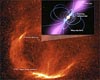 Stanford CA (SPX) Oct 23, 2008
About three times a second, the rotating corpse of a 10,000-year-old star sweeps a beam of gamma rays toward Earth. This object, known as a pulsar, is the first one known to "blink" at Earth only in gamma rays, and was discovered by an orbiting observatory launched in June with significant involvement from researchers at Stanford and the SLAC National Accelerator Laboratory. |
|
|

| The content herein, unless otherwise known to be public domain, are Copyright 1995-2007 - SpaceDaily.AFP and UPI Wire Stories are copyright Agence France-Presse and United Press International. ESA Portal Reports are copyright European Space Agency. All NASA sourced material is public domain. Additional copyrights may apply in whole or part to other bona fide parties. Advertising does not imply endorsement,agreement or approval of any opinions, statements or information provided by SpaceDaily on any Web page published or hosted by SpaceDaily. Privacy Statement |
 del.icio.us
 Digg
Digg Reddit
 YahooMyWeb
 Google
 Facebook