
What a view! It's late summer, after dark, and you're flat on your back in a sleeping bag watching the camp fire's last embers drift up to the heavens. Overhead a magnificent band of stars divides the night-it's the Milky Way. Now, imagine that scene doubled in brightness and beauty. No, that's not quite right. Imagine an entire galaxy of stars spinning overhead. The galaxy's blue-white core of young stars is surrounded by yellow octopus-arms of older siblings.
Off to one side a faint red column of gas meanders away from the starry whirlpool and turns in mid-sky toward … you.
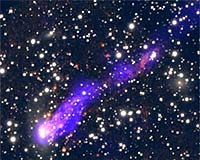
Astronomers using NASA's Chandra X-ray observatory have found a place in the Universe where the view may be like that. "It's near a galaxy named ESO 137-001," says Ming Sun of Michigan State University who led the study.
ESO 137-001 is a member of Abell Cluster 3627-a swarm of galaxies 65 Megaparsecs (212 million light years) from Earth. ESO 137-001 stands out among other galaxies in the cluster because it has a gigantic comet-like tail peppered with young stars. "We call them orphan stars," says MSU team member Megan Donahue, "because they are separating from their parent."
No one knows if there is life in these orphan star systems, but if there are lifeforms, "they would have a fantastic view," says Sun.
Here on Earth we see our own galaxy, the Milky Way, from the inside. Too bad! The interior of the Milky Way is choked with space-dust, which dims our view of all but the nearest stars. On any given summer night, the Milky Way displays only a fraction of its total glory. If only we could be lifted out of our busy, dusty spiral arm.
That's exactly what is happening in ESO 137-001, explains Sun. "Orphan stars are drifting away from their galaxy" to a point where the entire galaxy can be seen in hindsight. It's a stargazers dream come true.
How did this happen? Donahue explains: "Abell Cluster 3627 is filled with a diffuse atmosphere of hot gas which surrounds all the galaxies in the cluster. ESO 137-001 is moving through this gas as it plunges toward the cluster's center. The entire galaxy, therefore, feels a sort of 'hot wind' in its face." Note: Stick your head out the window of a car driving through Death Valley and you will feel a hot wind, too. It's the same concept. "The wind pushes raw, star-forming gas out the back of ESO 137-001, creating the comet-like tail where orphan stars are born."
This isn't the first time astronomers have detected stars being born outside a parent galaxy. "Other examples include Stephen's Quintet and NGC 4388," says Sun. "ESO 137-001 is special, however, because the rate of orphan star formation is so high: 36 to 5700 times greater than anything we've ever seen before." Sun estimates there could be a million stars spilling out of ESO 137-001, a million unbelievable night skies.
Eventually, as the stars slowly drift away from their parent, the view will change: ESO 137-001 will fade into the distance and a dark inter-galactic void will fill the night sky. The only stars in view then will be the orphans themselves–"a handful of very nearby, very bright points of light," says Donahue. "A few billion years from now these stars will be in a pretty lonely region of space."
Such isolation could be a good thing if life ever struggles to gain a foothold in these systems: "Planets circling orphan stars may be less affected by the occasional 'comet of death' perturbed out of its orbit by gravitational interactions with a passing star," speculates Donahue.
The orphan stars of ESO 137-001 may represent a whole population of cosmic wanderers, blessed in the beginning with breathtaking nights and in the end with the safety of the void. How many more are out there? No one knows.
"This," says Donahue, "is why we explore."
This month astronomers are celebrating the 8th anniversary of the Chandra X-ray Observatory with an "8 Years of Chandra" symposium in Huntsville, Alabama. Stay tuned to Science@NASA for reports of new discoveries and future plans revealed at the meeting.
