|
 |
 |
 |
 |
 |
 |
 |
 |
 |

| . |  |
. |
The One-And-A-Half Percent Solution
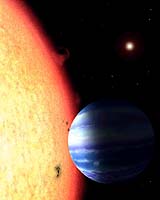
Moffett Field CA (SPX) Jul 12, 2005 More than 130 extrasolar planets have been discovered to date. Most of these have been found using a technique that measures tiny changes in a star's radial velocity, the speed of its motion relative to Earth. In a talk at a recent symposium on extrasolar planets, astronomer Alan Boss, of the Carnegie Institution of Washington, presented this overview of the difficult measurements - and the profound discoveries - made by planet-hunters using the radial-velocity technique. In 1991, Michel Mayor and Antoine Duquennoy published a classic survey of binary stars in our solar neighborhood. They found all the binary companions that they could, but there were another 200 or so G-type stars that didn't seem to have any binary companions. Subsequently, Michel Mayor, along with Didier Queloz, decided to look at these 200-odd stars, potential solar analogs, to see if they had planetary systems. The technique they used involved looking for stellar wobbles, cyclical changes in the stars' radial velocity, induced by the gravitational tug of orbiting planets. In the spring of 1994, they installed a new spectrometer on their telescope at the Haute Provence Observatory, ELODIE, which had a resolution of about 13 meters per second. This was just about the right level to be able to see the velocity wobble, the Doppler wobble, induced in the Sun by a Jupiter-like planet. By the end of 1994 they had noticed a very interesting wobble in a star called 51 Peg. Unfortunately, 51 Peg at that point was getting closer and closer to the Sun and couldn't be observed, so they had to take a 6-month sabbatical, and come back in the summer of 1995 and start looking at 51 Peg again. They had an 8-night observing run at the Haute Provence Observatory, and by the end of that observing run, they were ready to go to Nature and publish. The curve they produced fit a model of 51 Peg, a solar-type star, being orbited by a planet with roughly a half of a Jupiter mass, on a nice, circular orbit. The only problem was that the object had an orbital period of 4.23 days. It was orbiting in at about 0.05 AU, nowhere near where people had been expecting to find Jupiter-mass planets. So it was a bit of a puzzle. But it was clear early on that this had to be a planet, which perhaps had formed farther out and migrated in. That was the only way to explain how it could exist at that location. The next step was to see if anyone else could reproduce the result. Because, of course, the critical problem with the planet around Barnard's star was that no one could confirm it. There were several other planet-hunting efforts underway at the time in 1995, but the folks who got to the telescope first were Paul Butler and Geoff Marcy. They were able to confirm 51 Peg's planet, with even smaller scatter than the original discovery measurements. We realized at this point that the field of extrasolar planets had truly been born. In October 1995 a new era was entered, where we actually had convincing, solid proof of the existence of extrasolar planets around normal stars. Now Geoff and Paul had been working in this field for many years. They had actually started seriously around 1987, and so they had a lot of data ready to analyze. They immediately began to reduce all of their data, looking for short period orbits, took some more measurements, and by January of 1996, they were able to announce a couple more planets. One of them, 47 UMa b, was considerably more reassuring a planet than the one discovered orbiting 51 Peg. It was roughly a 2 or 3 Jupiter-mass object orbiting at a distance of 2 or so AU, more like what we were expecting to find based on the planets in our own solar system. We now know that this is a multiple-planet system, but at the time they fit it with a single Keplerian orbit. Almost all of the known extrasolar planets have been found using this radial-velocity technique; roughly 117 planets have been discovered that way. But there's another way of finding planets, transit detection. The first transit detection was achieved by David Charboneau and colleagues and separately by Greg Henry and colleagues in 2000. This was a planet which had been found originally by radial velocity, but then these other researchers went on and did both ground-based and later Hubble photometry of the host star and found a really wonderful light curve, indicative of the planet passing in front of the star, dimming its light slightly. The initial detection by Charbonneau's team was done, believe it or not, using a 4-inch telescope in a parking lot in Boulder, Colorado. The dip in the star's light amplitude is about 1.5 percent, so it's truly amazing that this very first transit detection could have been made by a good amateur telescope. When HST went back and re-did the photometry with much higher precision, it produced an incredibly beautiful light curve, which is so precise you could use it to try to search for moons around the planet and place limits on how large they could be. So transits are now coming into their own. I think they're the second leading way of finding planets. Six planets have been discovered by transits now. Related Links SpaceDaily Search SpaceDaily Subscribe To SpaceDaily Express  NASA Researchers Discover Planet With Largest Solid Core
 Tokyo, Japan (SPX) Jul 01, 2005
NASA researchers recently discovered the largest solid core ever found in an extrasolar planet, and their discovery confirms a planet formation theory. |
|
|

| The content herein, unless otherwise known to be public domain, are Copyright 1995-2006 - SpaceDaily.AFP and UPI Wire Stories are copyright Agence France-Presse and United Press International. ESA PortalReports are copyright European Space Agency. All NASA sourced material is public domain. Additionalcopyrights may apply in whole or part to other bona fide parties. Advertising does not imply endorsement,agreement or approval of any opinions, statements or information provided by SpaceDaily on any Web page published or hosted by SpaceDaily. Privacy Statement |