. Military Space News .
Timeline For Rosetta Encounter With Asteroid Steins

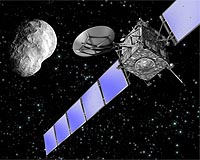
ESA's Rosetta spacecraft will fly by asteroid (2867) Steins on 5 September 2008 at 20:58 CEST, ground received time (= spacecraft time CEST + 20 minutes), with a closest approach distance of 800 km. Steins is Rosetta's first nominal scientific target. The spacecraft encountered the asteroid in the course of its first incursion into the main asteroid belt located between the orbits of Mars and Jupiter, while on its way to Comet 67P/Churyumov-Gerasimenko. The study of asteroids is extremely important because they represent a sample of Solar System material at different stages of evolution - key to understanding the origin of our own planet and of our planetary neighbourhood. Credits: ESA, image by C.Carreau
by Staff Writers
Paris, France (ESA) Sep 03, 2008
The Rosetta spacecraft control room is buzzing with anticipation as Rosetta closes in on asteroid 2867 Steins. The fly-by timeline includes a series of critical events, culminating with closest approach - expected at 20:58 CEST, 5 September 2008.

At the time of closest approach, Rosetta is planned to be 800 km from the asteroid, passing by at a speed of 8.6 km/s relative to Steins. Both Rosetta and Steins will be illuminated by the Sun, providing an excellent opportunity for science observations.

Between 40 and 20 minutes before closest approach, Rosetta will be flipped and the spacecraft will switch to a specially designed asteroid fly-by mode, an optimal configuration that supports the intensive observation and tracking activity of the on-board instruments.

Although most scientific observations will take place in the few hours around closest approach, several instruments will be switched on for a longer time around the event.

ESA's Cebreros deep space antenna (DSA 2) in Cebreros, Spain, will be used for communications with Rosetta in the two days preceding closest approach. When the spacecraft is not visible from Cebreros or New Norcia, NASA's DSN (Deep Space Network) ground stations at Goldstone, Canberra and Madrid will provide support for tracking and for science operations.

Around closest approach, Rosetta will be 2.41 Astronomical Units, or about 360 million km, from Earth. Radio signals sent to and from the spacecraft will have a 20 minute one-way travel time.

Timeline of nominal fly-by events

Note: All event times are stated in ground time, CEST.


Time        Event

1 September

02:20 Instruments switched on (except OSIRIS which was already on for the navigation campaign)

4 September

07:20-11:20 Slot for possible trajectory correction manoeuvre (36 hours before closest approach) 13:20-18:20 Last opportunity to acquire images for optical navigation campaign

5 September

07:20-10:20 Slot for possible trajectory correction manoeuvre (12 hours before closest approach) 10:20 Navigation cameras switch to tracking mode - initially both used, then use CAM 'A' only (to be decided) 11:00 Uplink fly-by commands for asteroid fly-by mode (AFM). Includes an update to the command profile already on board and the final updated AFM commands (only if 1 CAM at least is tracking) 20:18-20:38 Spacecraft flip over 20:39 Spacecraft switches automatically to asteroid fly-by mode 20:56 Sun illuminates Rosetta from the back and the asteroid fully 20:58 Closest approach, at a planned distance of 800 km from the asteroid 22:27 First post-fly-by acquisition of signal (AOS) - telemetry received via NASA's Goldstone ground station 22:30 Start of science data download via Goldstone

6 September

12:00 Live streaming of Rosetta Steins fly-by press conference from the European Space Operations Centre begins 13:00 Images from fly-by published on ESA web 15:00 End of press conference streaming 16:01 End of reception of first set of science data

Community
Email This Article
Comment On This Article

Share This Article With Planet Earth
del.icio.usdel.icio.us DiggDigg RedditReddit
YahooMyWebYahooMyWeb GoogleGoogle FacebookFacebook


Related Links
Rosetta blog
Asteroid and Comet Mission News, Science and Technology


Memory Foam Mattress Review
Newsletters :: SpaceDaily :: SpaceWar :: TerraDaily :: Energy Daily
XML Feeds :: Space News :: Earth News :: War News :: Solar Energy News


Dawn Advances Slowly
Pasadena CA (SPX) Aug 27, 2008
The Dawn spacecraft continues to make good progress on its adventure to unlock scientific secrets hidden deep in the main asteroid belt, between Mars and Jupiter. Its path to that distant realm of the solar system is now bringing it closer to the Sun, and thanks in part to all the thrusting it has accomplished with its remarkable ion propulsion system, it has recently achieved its lowest speed so far in the mission. To understand this enigmatic behavior, read on!


  • Analysis: NATO's new significant threats
  • Analysis: Russia's second chance
  • Russian general promises to 'destroy' any enemy: report
  • China cannot back Russia in Georgia crisis: analysts

  • Outside View: America's nuclear maneuver
  • Syria warns of 'catastrophic' effect of any Israeli strike on Iran
  • Russia says will complete Iran nuclear plant
  • Thousands of NKorea children face hardship in China: activists

  • Taiwan won't deploy longer-range missiles: report
  • Taiwan to mass-produce anti-ship missiles: report
  • Taiwan acquires Harpoon anti-ship missiles
  • LockMart Trident II D5 Missile Achieves 124 Successful Test Launches In A Row

  • Czechs expect first US funds from anti-missile deal: report
  • Outside View: BMD dilemmas -- Part One
  • Missile Defense Elements Participate In Air Force Test
  • BMD Games And The Caucasus Crisis Part One

  • Chinese airlines fly into headwinds in Olympic year
  • The M2-F1 - An Aircraft Without Wings
  • China's Tianjin building runway for Airbus test flights: report
  • NASA evaluates new wing sensor

  • LockMart Demos Airspace Deconfliction Of Multiple UAVs
  • Reaper Drops Laser-Guided Bomb On Anti-Iraqi Forces
  • QinetiQ's Zephyr UAV Unofficial World Record For Longest Unmanned Flight
  • Stellar Team's SATURN Wins At The MoD Grand Challenge

  • Immunity a sticking point in US-Iraq security pact: report
  • Dogs of War: Accountability gains ground
  • Maliki reshuffles Iraqi negotiating team: report
  • Feature: Sadr City gets new wall

  • Defense Focus: T-72s pack punch -- Part Two
  • ITT Receives Full-Fielding Recommendation For It's FRCS
  • Defenshield To Deploy MDFP And Barrier Caps To US Military
  • Packing A Punch With The T-72 Part One

  • The content herein, unless otherwise known to be public domain, are Copyright 1995-2007 - SpaceDaily.AFP and UPI Wire Stories are copyright Agence France-Presse and United Press International. ESA Portal Reports are copyright European Space Agency. All NASA sourced material is public domain. Additional copyrights may apply in whole or part to other bona fide parties. Advertising does not imply endorsement,agreement or approval of any opinions, statements or information provided by SpaceDaily on any Web page published or hosted by SpaceDaily. Privacy Statement