
 |
 |
 |
 |
 |
 |
 |
 |
 |
 |

| . |  |
. |
UI Researchers Make First Measurements Of The Solar Wind Termination Shock
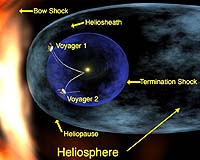
Iowa City IO (SPX) Jul 03, 2008 Two University of Iowa space physicists report that the Voyager 2 spacecraft, which has been traveling outward from the Sun for 31 years, has made the first direct observations of the solar wind termination shock, according to a paper published in the July 3 issue of the journal Nature. At the termination shock the solar wind, which continuously expands outward from the sun at over a million miles per hour, is abruptly slowed to a subsonic speed by the interstellar gas. Don Gurnett, professor of physics in the College of Liberal Arts and Sciences and principal investigator for the plasma wave instrument on Voyager 2, and Bill Kurth, UI research scientist and Voyager co-investigator, said that the shock crossing was marked by an intense burst of plasma wave turbulence detected by the UI instrument, as well as by various effects detected by other instruments on the spacecraft. At the time of the shock crossing, August 31, 2007, Voyager 2 was at a distance of 83.7 astronomical units (AU), roughly twice the distance between the Sun and Pluto. At this great distance, it took 11.2 hours for the radio signal from the spacecraft to reach Earth. Shock waves in the thin, ionized gas -- called plasma -- that exists in space are similar in some respects to the shock waves produced by an airplane in supersonic flight. Shock waves in space are believed to play an important role in the acceleration of cosmic rays, which are very energetic atomic particles that continually bombard Earth. The most energetic cosmic rays, which are potentially hazardous to astronauts, are believed to be produced in intense shock waves caused by supernova explosions -- immense stellar explosions that occur in massive stars toward the end of their lives. The termination shock is believed to be responsible for the origin of less energetic cosmic rays called "anomalous cosmic rays." The recent observations at the termination shock are expected to help physicists understand how cosmic rays are produced by the turbulent fields that exist in such shocks. Gurnett said,"There is no way for us to make direct measure of a super nova shock, so the Voyager 2 measurements at the termination shock provide us the best opportunity in the foreseeable future to understand how cosmic rays are produced by supernova cosmic shocks." Kurth noted that while some aspects of the termination shock matched scientists expectations, a number of the observations made by Voyager were surprising and will cause a number of theories to be revised. Gurnett noted that Voyager 2, launched in 1977, is moving at a speed of 38,000 miles an hour. Even at this considerable speed, the spacecraft will still take 30,000 years to reach a distance equal to that of the nearest star. Community Email This Article Comment On This Article Share This Article With Planet Earth
Related Links Sounds of Voyager's encounter with shock waves Solar Science News at SpaceDaily
 Solar Shield Experiment Aims To Keep The Power On
 Greenbelt MD (SPX) Jul 02, 2008
When you flip a light switch to illuminate the pages of your favorite book or reach into your refrigerator for that last piece of key lime pie, you expect the electric current coursing through the outlets to power everything from your lights to your nifty new big-screen television. When the power goes out, it can be more than just an inconvenience. |
|
|

| The content herein, unless otherwise known to be public domain, are Copyright 1995-2007 - SpaceDaily.AFP and UPI Wire Stories are copyright Agence France-Presse and United Press International. ESA Portal Reports are copyright European Space Agency. All NASA sourced material is public domain. Additional copyrights may apply in whole or part to other bona fide parties. Advertising does not imply endorsement,agreement or approval of any opinions, statements or information provided by SpaceDaily on any Web page published or hosted by SpaceDaily. Privacy Statement |
 del.icio.us
 Digg
Digg Reddit
 YahooMyWeb
 Google
 Facebook