
 |
 |
 |
 |
 |
 |
 |
 |
 |
 |

| . |  |
. |
USAF and Boeing Roll Out Flight Test Vehicle
Seal Beach, USA - September 5, 1997 - Seal Beach, USA - September 5, 1997 - The U.S. Air Force Phillips Laboratory and Boeing rolled out the first-phase flight test vehicle for the Air Force Space Maneuver Vehicle (SMV) program in ceremonies at Seal Beach on Wednesday. Boeing and its subcontractor team designed and built the SMV in the company's Seal Beach facility. The 22-foot-long vehicle with its 12-foot wing span is a 90% scale version of later-generation unpiloted space maneuver vehicles. The vehicle rolled out Wednesday will be the first to be flight-tested to demonstrate SMV autonomous approach and landing capability. In the long term, the Air Force Military Spaceplane program will feature small, unpiloted, powered SMVs functioning as reusable satellites to carry out space missions such as tactical reconnaissance and space object identification and surveillance. John A. McLuckey, president of the Boeing Space Systems business unit, told the audience at the rollout: "We're pleased with how far we have come in a short time to reach today's important milestone. We're excited that flight testing of our vehicle is about to begin and we're proud to be playing a number of key roles as we work with the Air Force to develop 21st century military space capabilities." The phase one space maneuver vehicle that the Air Force and Boeing rolled out Wednesday will pave the way for next-generation SMVs. Later this month, Boeing will ship the vehicle to Holloman Air Force Base, N.M. for a series of flight tests. In November, the vehicle will be towed aloft by a helicopter and released into unpowered flight from an altitude of approximately 10,000 feet to demonstrate autonomous high-speed guidance, navigation and control in the approach and landing phase. This Boeing project is under the direction of two organizations working in partnership on SMV development for 21st century military space roles: the Military Spaceplane Program Office of Phillips Laboratory at Kirtland Air Force Base, N.M.; and the USAF Wright Laboratory at Wright-Patterson Air Force Base, Ohio. Reuseable Launch Vehicle Archive at Spacer.Com
Rotary Kistler X-3X Other Space Planes General RLV Industry Issues  OrbView-2 Sends First Test Images
 Dulles, USA - September 4, 1997 -
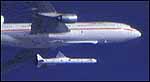
 Orbital Imaging Corporation, the Earth imaging subsidiary of Orbital Sciences Corporation, announced today its OrbView-2 satellite successfully reached operational orbit and collected its first test images of Earth. OrbView-2 was launched August 1, 1997, aboard Orbital's Pegasus XL launch vehicle. Pegasus deployed the OrbView-2 spacecraft into a circular "parking' orbit of 310 kilometers. Over August, Orbimage conducted an extensive series of spacecraft tests and determined that the satellite's operating systems are performing well. During this same period, the Orbimage ground team successfully commanded the OrbView-2 spacecraft to raise its orbit to an altitude of 705 kilometers through a series of 32 separate firings of the satellite's onboard hydrazine thrusters. |
|
|

|
|
|
|
|
|
|
|
|
|
|
|
| The content herein, unless otherwise known to be public domain, are Copyright 1995-2006 - SpaceDaily.AFP and UPI Wire Stories are copyright Agence France-Presse and United Press International. ESA PortalReports are copyright European Space Agency. All NASA sourced material is public domain. Additionalcopyrights may apply in whole or part to other bona fide parties. Advertising does not imply endorsement,agreement or approval of any opinions, statements or information provided by SpaceDaily on any Web page published or hosted by SpaceDaily. Privacy Statement |
