
SPACEWAR
US Space Force debuts first offensive weapons system
by Staff Writers
Washington DC (AFNS) Mar 16, 2020

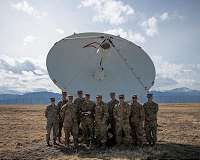
Airmen from the 4th Space Control Squadron take a picture in front of the Counter Communications System Block 10.2 on March 12 on Peterson Air Force Base, Colo. The 4th SPCS received the B10.2 from the Space and Missile Systems Center on Los Angeles Air Force Base, Calif. The B10.2 is a transportable space electronic warfare system that reversibly denies adversary satellite communications. (U.S. Air Force photo by Airman 1st Class Andrew Bertain)

The first offensive weapon system in the United States Space Force, the Counter Communications System Block 10.2, achieved Initial Operating Capability on March 9, providing quick reaction capability with direct operational support to the warfighter.

The Space and Missile Systems Center's Special Programs directorate and the 4th Space Control Squadron held a ceremony on March 12 to commemorate this historic event handing over a key to symbolize the transfer of responsibility from the space program office to the space operations unit at Peterson Air Force Base, Colo.

The Counter Communications System, first introduced in 2004, is a transportable space electronic warfare system that reversibly denies adversary satellite communications developed in partnership with L3Harris.Col. Stephen Purdy, SMC Special Programs director, said the benefits of CCS to deployed forces and warfighters cannot be overstated.

"CCS B10.2 represents the end of the traditional way of development," Purdy said. "Future upgrades and enhancements will make use of SMC's Agile DevSecOps (Development, Security and Operations) approach adapting to the evolving battlefield while delivering capabilities to the warfighter faster and better than our opponents."

Working with Total Force Airmen, the CCS team's efforts resulted in an effective certified training program for the space control operators and satellite communications maintenance personnel.

Air National Guard units in California, Colorado and Florida and Air Force active duty units like the 4th Space Control Squadron at Peterson Air Force Base, use the CCS. Members of the Air National Guard, including some who are also civilian employees of L3Harris, worked alongside active duty counterparts at SMC and the 721st Operations Group to test and deliver a cutting-edge space electronic warfare system since January.

"The advantage of the National Guard's unique relationship of citizen-Airmen working full-time in industry with mission partners like L3Harris, allows us to create a continuous feedback loop between system operators and contractors providing the best counter communications system," said Lt. Col. Warren Riner, Pentagon division chief, National Guard Bureau-space operations. "We look forward to continued success operationally with the new weapon system, and working with SMC and industry partners to support the United States Space Force."

Additionally, SMC went through a rigorous year-long test campaign that included both developmental and operational test events.

"Overall, the test campaign was extremely successful in demonstrating that CCS is operationally effective," Maj. Seth Horner, SMC program manager, said. "We could not have been successful if not for a highly integrated and skilled team from across the CCS enterprise."

"IOC signifies the start of CCS personnel and equipment support to USSPACECOM warfighting requirements for world-wide operations," said Lt. Col. Steve Brogan, materiel leader of the SMC Special Programs directorate. "Achieving IOC for this upgrade puts the 'force' in Space Force and is critical to Space as a warfighting domain."

With incremental software upgrades occurring since the early 2000s, SMC, along with its partner L3Harris, incorporated new techniques, frequency bands, technology refreshes and other lessons learned from its previous CCS block upgrades into CCS B10.2.


Related Links
US Space Force
Military Space News at SpaceWar.com

SPACEWAR
Lockheed Martin to develop Prototype Protected Tactical Satellite Communications payload
Denver CO (SPX) Mar 10, 2020
The U.S. Space Force's Space and Missile Systems Center (SMC) at Los Angeles Air Force Base awarded Lockheed Martin a $240 million contract to develop a prototype payload for its new Protected Tactical SATCOM (PTS) system. PTS is a next-generation capability connecting warfighters with more agile and jam-resistant satellite communications (SATCOM). The complete system will deploy a constellation of dedicated geostationary satellites, commercially hosted payloads, and coalition partner satellites i ... read more

Comment using your Disqus, Facebook, Google or Twitter login.

Share this article via these popular social media networks
del.icio.usdel.icio.us DiggDigg RedditReddit GoogleGoogle

SPACEWAR
Missile Defense Agency's Long Range Discrimination Radar closer to delivery

Arrows of misfortune as US Missile Defence needs upgrading

Syrian air defence responds to 'Israeli missiles': state media

Syrian air defence responds to 'Israeli missiles': state media

SPACEWAR
US approves anti-tank missile sale to Poland

Russia successfully test fires Tsirkon hypersonic cruise missile

Lockheed Martin nabs $1.1B to provide GMLRS to Romania, South Korea

Raytheon awarded $90.4M for JMEWS warheads for Tomahawk missiles

SPACEWAR
Turkish drones kill 19 Syrian government soldiers as tensions soar

Navy installs ODIN laser weapon system to counter aerial drones

Ground-breaking solar powered unmanned aircraft makes first flight

UAV's Flight Control Solutions compatible with Trimble's UAS1

SPACEWAR
L3Harris nabs $383.2M to provide man pack radio systems for Marines

Lockheed Martin's Most Advanced Mobile Communications Satellite Launches

Space and Missile Systems Center awards Northrop Grumman $253.6 million for Protected Tactical SATCOM acquisition

AEHF-5 Satellite Control Authority Transferred to Space Operations Command

SPACEWAR
AFRL creates safer-than-steel synthetic winch cable for cargo aircraft

Intelligent fuze detects and destroys deeply buried targets

This wearable device camouflages its wearer no matter the weather

Army to buy additional BONUS munitions for howitzers

SPACEWAR
Pentagon 'wishes to reconsider' awarding JEDI contract to Microsoft

US, Brazil sign agreement enabling military sales

As global arms trade thrives, US widens gap with Russia: report

State department approves $325.5M arms deal to Tunisia

SPACEWAR
Two dead, nine hurt in fresh east Ukraine unrest

US, Canadian jets intercept Russian reconnaissance aircraft

China slams US for warship sail-by in disputed waters

China, US spar over origin of coronavirus

SPACEWAR
New DNA origami motor breaks speed record for nano machines

Deep-sea osmolyte makes biomolecular machines heat-tolerant

Nanobubbles in nanodroplets

New production method for carbon nanotubes gets green light