|
 |
 |
 |
 |
 |
 |
 |
 |
 |

| . |  |
. |
US team in North Korea to begin disabling nuclear facilities
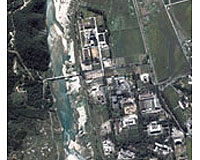
Beijing (AFP) Nov 1, 2007 A team of US atomic inspectors arrived in North Korea on Thursday after expressing confidence that the historic disablement of the isolated nation's nuclear facilities would go smoothly. North Korea has pledged to begin taking apart its nuclear facilities, going further than it ever has before in meeting foreign pressure to scrap atomic capabilities it has been building up since the 1950s. The nine-member US team arrived in the North Korean capital Pyongyang on a flight from Beijing, China's state-run Xinhua news agency said. They are destined for the main Yongbyon atomic reactor where they will supervise disablement work expected to begin next week. "They are all very highly motivated and ready to go on with the first stages of the actual disablement," Assistant Secretary of State Christopher Hill told reporters in Beijing earlier. "We are very satisfied that we have an overall plan that will be effective and that will provide the disablement that we need." Hill was the US negotiator in a six-nation accord struck in February that would see the North completely abandon its nuclear weapons programmes, with the disabling one of the key initial phases in that process. The work centres mainly on Yongbyon, where weapons-grade plutonium has been made. "We would like to start as soon as possible," Sung Kim, leader of the US team, told reporters before leaving Beijing. "I think as soon as we are set up in Yongbyon we will begin. Hopefully early next week," said Kim, director of the State Department's Korean affairs office. The team's arrival follows years of tortuous six-nation negotiations that also involve China, South Korea, Japan and Russia. Amid that process, the reclusive nation conducted its first atomic weapons test in October last year, spurring a renewed six-nation push which resulted in North Korea agreeing in February to completely denuclearise. In exchange, it has been promised one million tonnes of fuel oil, some of which has already been delivered, plus wide-ranging diplomatic incentives that could potentially see it establish formal ties with the United States. Kim said disablement would involve physically taking apart equipment, with the US team and North Koreans working side by side. "I think it will be a combined effort with some North Korean help and of course our experts supervising and coordinating," Kim said, adding that there were no significant remaining procedural disagreements. Any attempt to revive disabled systems would take a "considerable amount of time," he said, without providing a specific estimate. Under the accord, disablement is required to be finished by December 31. A 1994 disarmament deal with the United States, which eventually collapsed, saw North Korea only freeze the Yongbyon reactor, which it eventually restarted. Hill said the start of disablement validated the six-nation process, and he praised the leadership of six-nation talks host China -- the North's neighbour and most important ally. "We believe the Chinese really have done an excellent job. They have really shown great diplomatic capabilities," he said. However, Pyongyang has a history of raising last-minute hurdles, and Hill warned that success could not be declared until the North gave up all nuclear material and its atomic facilities were "irreversibly" dismantled. Under the six-nation pact, those steps are due to start early in 2008. "We have a long way to go," Hill said. He deflected questions about whether the same diplomatic approach should be applied to the Iran nuclear impasse, in which the White House is maintaining a hard line, calling it a "different situation, a different region." Community Email This Article Comment On This Article Related Links Learn about nuclear weapons doctrine and defense at SpaceWar.com Learn about missile defense at SpaceWar.com All about missiles at SpaceWar.com Learn about the Superpowers of the 21st Century at SpaceWar.com
 NKorea set to abandon nuke ambitions, Seoul says
 Seoul (AFP) Oct 31, 2007
North Korea will take the first step towards completely abandoning its nuclear ambitions when work starts soon to disable its atomic plants, South Korea's foreign minister said Wednesday. |
|
|

| The content herein, unless otherwise known to be public domain, are Copyright 1995-2006 - SpaceDaily.AFP and UPI Wire Stories are copyright Agence France-Presse and United Press International. ESA PortalReports are copyright European Space Agency. All NASA sourced material is public domain. Additionalcopyrights may apply in whole or part to other bona fide parties. Advertising does not imply endorsement,agreement or approval of any opinions, statements or information provided by SpaceDaily on any Web page published or hosted by SpaceDaily. Privacy Statement |