
 |
 |
 |
 |
 |
 |
 |
 |
 |
 |

| . |  |
. |

Evanston IL (SPX) Sep 08, 2010 Seven years ago Northwestern University physicist Adilson E. Motter conjectured that the expansion of the universe at the time of the big bang was highly chaotic. Now he and a colleague have proven it using rigorous mathematical arguments. The study, published by the journal Communications in Mathematical Physics, reports not only that chaos is absolute but also the mathematical tools that can be used to detect it. When applied to the most accepted model for the evolution of the universe, these tools demonstrate that the early universe was chaotic. Certain things are absolute. The speed of light, for example, is the same with respect to any observer in the empty space. Others are relative. Think of the pitch of a siren on an ambulance, which goes from high to low as it passes the observer. A longstanding problem in physics has been to determine whether chaos - the phenomenon by which tiny events lead to very large changes in the time evolution of a system, such as the universe - is absolute or relative in systems governed by general relativity, where the time itself is relative. A concrete aspect of this conundrum concerns one's ability to determine unambiguously whether the universe as a whole has ever behaved chaotically. If chaos is relative, as suggested by some previous studies, this question simply cannot be answered because different observers, moving with respect to each other, could reach opposite conclusions based on the ticks of their own clocks. "A competing interpretation has been that chaos could be a property of the observer rather than a property of the system being observed," said Motter, an author of the paper and an assistant professor of physics and astronomy at Northwestern's Weinberg College of Arts and Sciences. "Our study shows that different physical observers will necessarily agree on the chaotic nature of the system." The work has direct implications for cosmology and shows in particular that the erratic changes between red- and blue-shift directions in the early universe were in fact chaotic. Motter worked with colleague Katrin Gelfert, a mathematician from the Federal University of Rio de Janeiro, Brazil, and a former visiting faculty member at Northwestern, who says that the mathematical aspects of the problem are inspiring and likely to lead to other mathematical developments. An important open question in cosmology is to explain why distant parts of the visible universe - including those that are too distant to have ever interacted with each other - are so similar. "One might suggest 'Because the large-scale universe was created uniform,'" Motter said, "but this is not the type of answer physicists would take for granted." Fifty years ago, physicists believed that the true answer could be in what happened a fraction of a second after the big bang. Though the initial studies failed to show that an arbitrary initial state of the universe would eventually converge to its current form, researchers found something potentially even more interesting: the possibility that the universe as a whole was born inherently chaotic. The present-day universe is expanding and does so in all directions, Motter explained, leading to red shift of distant light sources in all three dimensions - the optical analog of the low pitch in a moving siren. The early universe, on the other hand, expanded in only two dimensions and contracted in the third dimension. This led to red shift in two directions and blue shift in one. The contracting direction, however, was not always the same in this system. Instead, it alternated erratically between x, y and z. "According to the classical theory of general relativity, the early universe experienced infinitely many oscillations between contracting and expanding directions," Motter said. "This could mean that the early evolution of the universe, though not necessarily its current state, depended very sensitively on the initial conditions set by the big bang." This problem gained a new dimension 22 years ago when two other researchers, Gerson Francisco and George Matsas, found that different descriptions of the same events were leading to different conclusions about the chaotic nature of the early universe. Because different descriptions can represent the perspectives of different observers, this challenged the hypothesis that there would be an agreement among different observers. Within the theory of general relativity, such an agreement goes by the name of a "relativistic invariant." "Technically, we have established the conditions under which the indicators of chaos are relativistic invariants," Motter said. "Our mathematical characterization also explains existing controversial results. They were generated by singularities induced by the choice of the time coordinate, which are not present for physically admissible observables."
Share This Article With Planet Earth
Related Links Northwestern University Understanding Time and Space

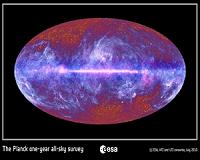 Planck Takes It All In
Paris, France (ESA) Jul 08, 2010 A new image from the Planck mission shows what it's been up to for the past year - surveying the entire sky for clues to our universal origins. Planck, a European Space Agency mission with significant participation from NASA, has been busily scanning the whole sky at nine frequencies of light, with the ultimate goal of isolating fluctuations in the cosmic microwave background - or light from the ... read more |
|
|
| The content herein, unless otherwise known to be public domain, are Copyright 1995-2010 - SpaceDaily. AFP and UPI Wire Stories are copyright Agence France-Presse and United Press International. ESA Portal Reports are copyright European Space Agency. All NASA sourced material is public domain. Additional copyrights may apply in whole or part to other bona fide parties. Advertising does not imply endorsement,agreement or approval of any opinions, statements or information provided by SpaceDaily on any Web page published or hosted by SpaceDaily. Privacy Statement |


 del.icio.us
 Digg
Digg Reddit
 YahooMyWeb
 Google
 Facebook


