|
 |
 |
 |
 |
 |
 |
 |
 |
 |

| . |  |
. |
Venus Express Marks One Year In Orbit
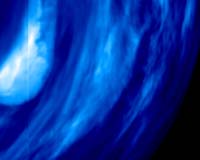
Paris, France (SPX) Nov 10, 2006 One year after its launch on 9 November 2005 and a few months into its science phase, ESA's Venus Express keeps working well and continues to gather lots of data about the hot and noxious atmosphere of the planet. Newly released images show additional details of the thick cloud deck that surrounds Venus. It was 11 April 2006 when, after a delicate manoeuvre, Venus Express entered into orbit around Venus, and started a series of gradually smaller loops around the planet to reach its 24-hour science orbit (spanning between 66 000 over the South pole and 250 kilometres over the North pole) on 7 May 2006. "From that time onwards this unique spacecraft, equipped with the most advanced instruments ever used for atmospheric investigations at Venus, has started gathering views and information on the thick atmosphere, its cloud system and its dynamics - during experiment tests in the beginning, and on a nominal basis after 4 June 2006," said Hakan Svedhem, Venus Express Project Scientist. From the very first images of the approaching planet and from the South Pole views obtained on 12 April - the first of this area taken in the infrared in the history of Venus' exploration - scientists immediately obtained novel glimpses about an extraordinarily complex weather system. This is ruled by huge and still largely unexplained forces at work in the atmosphere, causing hurricane-force winds and generating the amazing double-eyed vortices over both poles. It was indeed this European spacecraft to entirely reveal for the first time the double vortex over the planet's South pole, with its 3D structure so much differentiated over different altitudes and similarly shaped (but mirrored) to that present over the North pole. Newly released images, obtained in July and September 2006 by the Visible and Infrared Thermal Imaging Spectrometer (VIRTIS) on board Venus Express, show new details of the cloud structure. This thick layer of clouds, located around 60 kilometres altitude over the surface, blocks part of the thermal radiation coming from below. However, VIRTIS is designed to catch the only radiation that can pass through the lower atmopshere and the cloud deck, making use of the so called 'infrared windows'. Through these 'windows', thermal (infrared) radiation at specific wavelengths can cross the lower atmosphere and escape towards space. By doing so, it carries information about the lower atmospheric layers and the surface that VIRTIS can collect from orbit. The first, false-colour night-side image (see top of the article), was taken at a 1.7-micrometre wavelength on 23 September 2006, when the spacecraft was flying at about 60 000 kilometres over the planet around the point of furthest distance from the surface (apocentre). It shows an area close to the South pole (out of the field of view beyond the top left of the image). "The bright big spot on the left of the image corresponds to an area where the cloud deck is thinner," said Giuseppe Piccioni, VIRTIS co-Principal Investigator. "Such regions, similar to large holes, allow the thermal radiation from below the clouds layer to increase significantly with respect to the surrounding areas, and make it possible to probe very deep in the atmosphere with a limited attenuation from the clouds." The atmospheric layers below the cloud deck, and the fact that they are blocking almost all thermal radiation coming from the surface, are the main responsible for the tremendous green-house effect at work on the planet - the most powerful found in the Solar System. It maintains the surface temperature as high as 450C!
The second, night-side image of the southern hemisphere was taken by VIRTIS on 29 July 2006 from a distance of about 64 000 kilometres over the surface (around the orbit apocentre) at a wavelength of 1.7 micrometres. The South pole is visible on the top left of the image. This image provides a remarkable example of a wave structure, running from the bottom to the top-right, each 'wave' extending about 150 kilometres. This peculiar cloud feature is often seen at a latitude of about 55 South. "Despite the fact that the cloud structure is very variable and dynamic at Venus, recurrent patterns and structures tend to appear in the same locations," said Pierre Drossart, VIRTIS co-Principal Investigator. "They are mostly visible in the infrared, sometimes very easily, some other times less. When they are very faint and hidden, we need to play with the intensity of the images." The picture also shows a part of the polar vortex (top left). Regions of thinner clouds are present also in this image. They are visible as bright spots (top left corner), as they allow more thermal radiation to escape towards deep space from the hotter regions below. The region between the black stripe around the pole and the wave structure contains the so called 'cold collar', a region in which the temperature of the clouds is lower than that of the surrounding area. Similar cold-collar structures are present at both poles. The cold collar over the South pole cannot be clearly seen in this image (1.7 micrometre wavelenght), but it was was imaged by VIRTIS at 5 micrometres in April 2006. In the meantime, VIRTIS and the other instruments on board Venus Express keep observing the mysterious atmosphere of Venus. Well done so far and...happy anniversary, Venus Express! Related Links Venus Express Hot Stuff At Venus  Complex Meteorology At Venus
 Paris, France (SPX) Oct 16, 2006
In its relentless probing of Venus's atmosphere, ESA's Venus Express keeps revealing new details of the Venusian cloud system. Meteorology at Venus is a complex matter, scientists say. |
|
|

| The content herein, unless otherwise known to be public domain, are Copyright 1995-2006 - SpaceDaily.AFP and UPI Wire Stories are copyright Agence France-Presse and United Press International. ESA PortalReports are copyright European Space Agency. All NASA sourced material is public domain. Additionalcopyrights may apply in whole or part to other bona fide parties. Advertising does not imply endorsement,agreement or approval of any opinions, statements or information provided by SpaceDaily on any Web page published or hosted by SpaceDaily. Privacy Statement |