|
 |
 |
 |
 |
 |
 |
 |
 |
 |

| . |  |
. |
Venus Express Transmits First Images
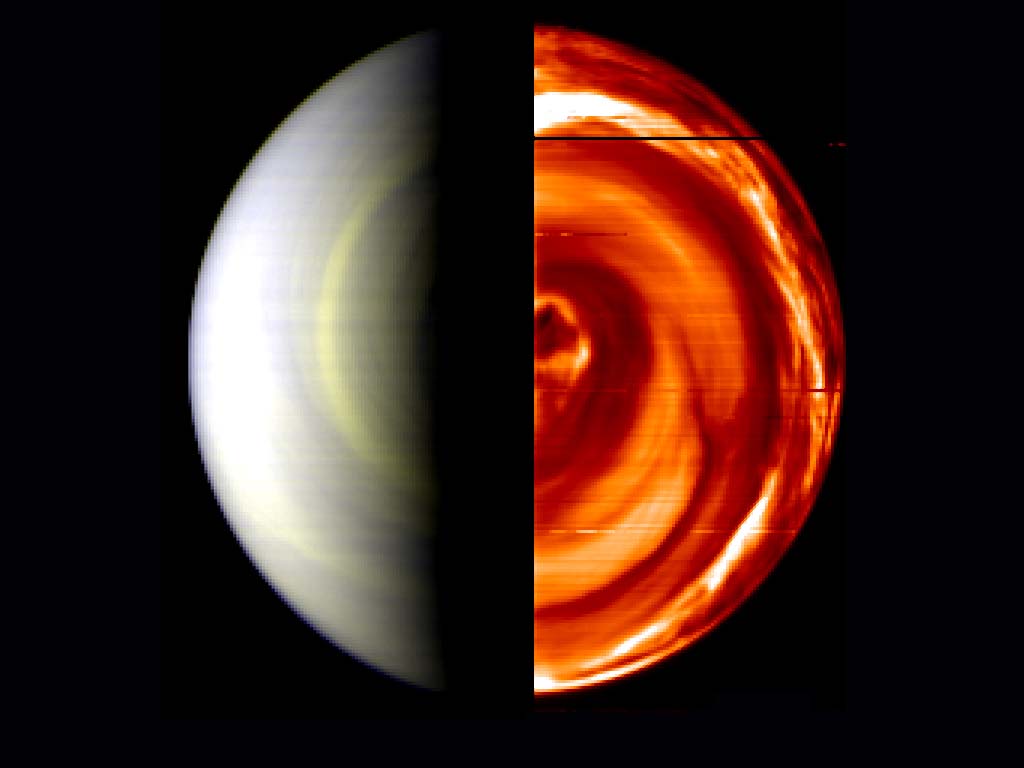
Darmstadt, Germany (SPX) Apr 17, 2006 ESA's Venus Express orbiter returned its first images of the veiled planet Wednesday, beginning with a striking view of the Venusian south pole in both visible and infrared light. The spacecraft's cameras took the image from a distance of about 200,000 kilometers (125,000 miles), showing surprisingly clear structures and unexpected detail. Venus Express took the image during its initial capture orbit after successful arrival April 11. Mission controllers have been activating several of the instruments, including the Venus Monitoring Camera, or VMC, and the Visible and Infrared Thermal Imaging Spectrometer, or VIRTIS. Those instruments took the combined image, revealing the southern hemisphere of Venus for the first time as the spacecraft passed below the planet in an elliptical arc. ESA scientists said they were particularly intrigued by the dark vortex shown almost directly over the south pole, a previously suspected but unconfirmed structure that corresponds to a similar cloud pattern above the planet's north pole. "Just one day after arrival, we are already experiencing the hot, dynamic environment of Venus," said project scientist Hakan Svedhem. "We will see much more detail at an unprecedented level as we get over 100 times better resolution as we get closer to Venus, and we expect to see these spiral structures evolve very quickly." Even though the polar images are preliminary and of relatively low quality, mission scientists said they were struck by the surprisingly clear structures and unexpected details shown in the VIRTIS spectrometer image. The false-color composite image shows the Venusian day side at left and night side at right, and corresponds to a scale of 50 kilometers (30 miles) per pixel. The day half also is a composite image taken via wavelength filters, and it mainly shows sunlight reflected from the tops of clouds down to a height of about 65 kilometers (40 miles) above the planet's surface. The more spectacular night half, shown in reddish false color, was taken through an infrared filter at a wavelength of 1.7 microns. It shows dynamic spiral cloud structures in the lower atmosphere, at an altitude of about 55 kilometers (34 miles). The darker regions correspond to thicker cloud cover, while the brighter regions correspond to thinner clouds, allowing hot thermal radiation from lower altitudes to be imaged. Venus Express now is in its first nine-day capture orbit, on its way to the apocenter (maximum height) at 350,000 kilometers (220,000 miles) below the south pole. It will swing back up to pass pericenter (minimum height) at an altitude of only 250 kilometers (155 miles) above the planet's north pole. During the first capture orbit, Venus Express will compile images and gather data five more times before reaching pericenter. The observations represent a great opportunity, mission scientists said, because at apocenter the full disc of Venus will become fully visible for the spacecraft's imagers. Such opportunities will not occur again during the formal mission, which begins June 4, when the range of distances from the planet will be much smaller. Along with the VMC and VIRTIS, controllers also switched on the spacecraft's Venus Express Magnetometer, or MAG, for initial verification, and they reported it is operating nominally. Together with the Analyzer of Space Plasma and Energetic Atoms, or ASPERA, the two instruments are expected to gather information about the unperturbed solar wind and the atmospheric escape processes on Venus, a planet with no magnetic protection. Controllers are planning a series of further engine and thruster burns to reduce the apocenter gradually during the next 16 orbital loops around the planet, and the spacecraft is due to attain its final 24-hour polar orbit on May 7. At that point, it will range from 66,000 kilometers to 250 kilometers (41,000 miles to 155 miles) above Venus. Venus Express is designed to conduct detailed observations of the structure, chemistry and dynamics of the planet's atmosphere for at least two Venusian days - or 486 Earth days. Related Links Venus Express at ESA  ESA Spacecraft Prepares To Lift Venusian Veil
 Darmstadt, Germany (SPX) Apr 12, 2006
ESA's Venus Express has matched the planned geometry of its initial orbit and so far is performing flawlessly, ground controllers at the agency's European Spacecraft Operations Centre said Tuesday. |
|
|

| The content herein, unless otherwise known to be public domain, are Copyright 1995-2006 - SpaceDaily.AFP and UPI Wire Stories are copyright Agence France-Presse and United Press International. ESA PortalReports are copyright European Space Agency. All NASA sourced material is public domain. Additionalcopyrights may apply in whole or part to other bona fide parties. Advertising does not imply endorsement,agreement or approval of any opinions, statements or information provided by SpaceDaily on any Web page published or hosted by SpaceDaily. Privacy Statement |