
 |
 |
 |
 |
 |
 |
 |
 |
 |
 |

| . |  |
. |

Rome, Italy (SPX) Sep 24, 2010 Despite the great differences between the atmospheres of Venus and Earth, scientists have discovered that very similar mechanisms produce lightning on the two planets. The rates of discharge, intensity and spatial distribution of lightning are comparable. Findings will help scientists understand the chemistry, dynamics and evolution of the atmospheres of the two planets. These results will be presented by Dr. Christopher Russell at the European Planetary Science Congress. Previous missions, such as the Venera, Pioneer Venus and Galileo spacecraft, have reported evidence for optical and electromagnetic waves from Venus that could be produced by lightning. This has also been supported by ground-based telescopes capturing lighting flashes at Venus. Yet the differences in the two atmospheres have led some to claim that lightning on Venus would be unlikely and the topic has been controversial. The launch of Venus Express with its magnetometer built by the Space Research Institute in Graz, Austria, has provided an opportunity to confirm the occurrence of lightning on Venus and to study in detail its magnetic field at altitudes between 200 and 500 km. "Short strong pulses of the signals expected to be produced by lightning were seen almost immediately upon arrival at Venus, despite the generally unfavorable magnetic field orientation for entry of the signals into the Venus ionosphere at the altitude of the Venus Express measurements," says Dr. Russell of the University of California, USA. When clouds form, on Earth or Venus, the energy that the Sun has deposited in the air can be released in a very powerful electrical discharge. As cloud particles collide, they transfer electrical charge from large particles to small, and the large particles fall while the small particles are carried upward. The separation of charges leads to lightning strokes. This process is important for a planetary atmosphere because it raises the temperature and pressure of a small portion of the atmosphere to a very high value so that molecules can form, which would not otherwise occur at standard atmospheric temperatures and pressures. This is why some scientists have speculated that lightning may have helped life to arise on Earth. On our planet, about 100 lightning discharges occur per second, but from any one location we see far fewer. Similarly on Venus we do not see the entire planet and we have to estimate the total occurrence rate with some assumptions about how far one can see. Thanks to the new datasets from Venus Express, Dr. Russell and colleagues were able to show that lightning is similar in strength on Earth and Venus at the same altitudes. "We have analyzed 3.5 Earth-years of Venus lightning data using the low-altitude Venus Express data (10 minutes per day). By comparing the electromagnetic waves produced at the two planets, we found stronger magnetic signals on Venus, but when converted to energy flux we found very similar lightening strength," reports Dr. Russell. It also seems that lightning is more prevalent on the dayside than at night and happens more often at low Venusian latitudes where the solar input to the atmosphere is strongest. "Venus and Earth are often called twin planets because of their similar size, mass, and interior structure. The generation of lightning is one more way in which Venus and Earth are fraternal twins," says Dr. Russell.
Share This Article With Planet Earth
Related Links EPSC 2010 Venus Express News and Venusian Science

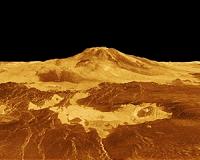 Hot Atmosphere Of Venus May Cool Planet's Interior
Rome, Italy (SPX) Sep 24, 2010 The heat in the atmosphere of Venus, induced from a strong greenhouse warming, might actually have a cooling effect on the planet's interior. This counter-intuitive theory is based on calculations from a new model presented at the European Planetary Science Congress (EPSC) in Rome on Tuesday 21st September. "For some decades we've known that the large amount of greenhouse gases in the atmo ... read more |
|
|
| The content herein, unless otherwise known to be public domain, are Copyright 1995-2010 - SpaceDaily. AFP and UPI Wire Stories are copyright Agence France-Presse and United Press International. ESA Portal Reports are copyright European Space Agency. All NASA sourced material is public domain. Additional copyrights may apply in whole or part to other bona fide parties. Advertising does not imply endorsement,agreement or approval of any opinions, statements or information provided by SpaceDaily on any Web page published or hosted by SpaceDaily. Privacy Statement |


 del.icio.us
 Digg
Digg Reddit
 YahooMyWeb
 Google
 Facebook


