
 |
 |
 |
 |
 |
 |
 |
 |
 |
 |

| . |  |
. |
When Worlds Collide You Get Space Potatoes
for Astrobiology Magazine Moffett Field (SPX) Jul 07, 2008 The asteroids that pepper our solar system come in all shapes, sizes and ages. What causes such a variety among space rocks has been something of a mystery, until now. Researchers have been using a vast database to study a staggering 11,735 asteroids. They have discovered that asteroids change shape over time, and they think they know the reason why. Our Turbulent Solar System Gyula Szabo from the University of Szeged is the lead author of the study, which was published in the July edition of Icarus. He explains, "there are several hundred thousand asteroids in our solar system. They orbit the sun, but because they are small their surface gravity is low. This means that many have strange, irregular shapes." Scientists like Gyula think that about one third of known asteroids belong to groups called "families." These clusters probably formed from piles of debris after larger objects collided.
Resolved to Save Time Another option for obtaining information about asteroids is called "time-resolved photometry." The technique is surprisingly simple: by observing asteroids as they spin in space and then studying the amount of light reflected, scientists can get an idea of their shape. Getting accurate results from this method can take a long time, but the researchers realised that digital sky surveys could speed up the process. Such projects study thousands of objects every night. The Sloan Digital Sky Survey, for instance, mainly looks at stars and galaxies, but it also has gathered data on asteroids. "This procedure was very economical," says Gyula. "Using photometry, astronomers have determined shapes for about 1,200 asteroids in the past 30 to 40 years. We derived the shapes for ten times more asteroids, but in half an hour!"
Surprising Results In young groups of asteroids there are a great variety of shapes, hinting that they formed relatively recently from fragments of rock that later bound together. Asteroids in older families tend to be rounder. It seems to take one to two billion years for irregular asteroids to be transformed into smooth balls. But what changes the asteroids' shape? Gyula and his team have shown that asteroids change shape from elongated to roughly spherical due to being impacted during their lifetimes. They are like pebbles on the beach that become worn smooth over many years - only in space, erosion is caused by small impacts as rocks knock into each other and chip pieces off. Impact specialist Jonti Horner from the UK's Open University agrees with Gyula. "The results make sense," he says. "Catastrophic impacts create a huge slew of fragment shapes, like the shards of a broken bottle. The debris then are weathered over time and smoothed towards sphericality by small impacts." Impacts are part of the fundamental processes in our solar system. They were part of the planet formation process 4.5 billion years ago, and still occur today. "Sometimes astronomers have to be archeologists, too," says Gyula. "This work is a fine example of how we can deduce a billion-year process from the world we observe today." Hopefully, this research will not only teach us more about how the solar system operates, but will help us prepare for future impact events. Learning all we can about asteroids could help us avoid disaster if we ever detect a large, fast-moving one on a collision course with the Earth. Community Email This Article Comment On This Article Share This Article With Planet Earth
Related Links Asteroid and Comet Mission News, Science and Technology
 Asteroid-Hunting Satellite A World First
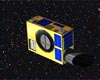 Calgary, Canada (SPX) Jun 27, 2008
Canada is building the world's first space telescope designed to detect and track asteroids as well as satellites. Called NEOSSat (Near Earth Object Surveillance Satellite), this spacecraft will provide a significant improvement in surveillance of asteroids that pose a collision hazard with Earth and innovative technologies for tracking satellites in orbit high above our planet. |
|
|

| The content herein, unless otherwise known to be public domain, are Copyright 1995-2007 - SpaceDaily.AFP and UPI Wire Stories are copyright Agence France-Presse and United Press International. ESA Portal Reports are copyright European Space Agency. All NASA sourced material is public domain. Additional copyrights may apply in whole or part to other bona fide parties. Advertising does not imply endorsement,agreement or approval of any opinions, statements or information provided by SpaceDaily on any Web page published or hosted by SpaceDaily. Privacy Statement |
 del.icio.us
 Digg
Digg Reddit
 YahooMyWeb
 Google
 Facebook