
 |
 |
 |
 |
 |
 |
 |
 |
 |
 |

| . |  |
. |
Wild Cousin Emerges from Family Tree of Supernova
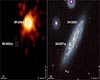
Chicago IL (SPX) Sep 30, 2008 Astronomers may have discovered the relative of a freakishly behaving exploding star once thought to be the only one of its kind. For more than two decades, astronomers have intensively studied supernova 1987A, an exploding star that had behaved like no other. Instead of growing dimmer with time, 1987A has grown brighter at X-ray and radio wavelengths. A team of astronomers that includes the University of Chicago's Vikram Dwarkadas is asking if supernova 1996cr, discovered by Columbia University's Franz Bauer, is actually the "wild cousin" of supernova 1987A. "This may be the second case, after '87a, where we see emission that's increasing dramatically," said Dwarkadas, Senior Research Associate in Astronomy and Astrophysics at Chicago. "Normally, you would expect the emission to decrease over time." In a new paper published in the Astrophysical Journal, Bauer, Dwarkadas and five co-authors call 1996cr a potential "wild cousin" of the earlier supernova. "These two look alike in many ways, except this newer supernova is intrinsically 1,000 times brighter," Bauer said. Supernova 1996cr is located 12 million light years from Earth in the spiral galaxy Circinus, making it one of the nearest-known exploding stars of the last quarter-century. When 1996cr exploded in the mid-1990s, no one noticed. Bauer first detected the object in 2001 using NASA's Chandra X-ray Observatory. Although intrigued by its exceptional qualities, Bauer, then at Pennsylvania State University, and his associates were unable to verify it as a supernova. But recently acquired data from the European Southern Observatory's Very Large Telescope in Chile prompted further investigation. After searching archival images from Australia's Anglo-Australian Telescope, Bauer determined that the explosion occurred between Feb. 28, 1995, and March 15, 1996. All told, Bauer's team examined data from 18 different telescopes, both orbiting and ground-based, nearly all of it coming from the observatories' Internet archives. Most supernovas grow dimmer with the passage of time as they release their energy. But the X-ray and radio emissions from 1987A grew brighter because its shock wave had crashed into a dense cloud of gas and dust. Supernova shock waves initially move at speeds of 10,000 miles or more each second. According to the calculations of Dwarkadas and other theoreticians, these interstellar gas clouds form a bubble around stars at least eight times more massive than the sun, possibly the product of smaller upheaval or a lifetime of mass-loss from solar wind emissions that took place before the supernova. These wind-blown bubbles, as astronomers call them, are like a balloon: empty in the middle with a shell around the outside. The explosion moves rapidly through the cavity for several years because there's almost nothing to stop it. "Then it hits this dense shell. It slows down and begins to give off a lot of emission," Dwarkadas said. Supernovas close enough to be studied in such detail come by only once a decade, Bauer said. "It's a bit of a coup to find SN1996cr in the manner we did, and we could never have nailed it without the serendipitous data taken by all of these telescopes. We've truly entered a new era of 'Internet astronomy,'" he said. Co-authors of the paper included Niel Brandt, Penn State; Stefan Immler, NASA Goddard Space Flight Center; Norbert Bartel, York University, Canada; and Michael Bietenholz, York University and Hartebeesthoek Radio Observatory, South Africa. The National Science Foundation, the National Aeronautic and Space Administration, and the European Science Foundation provided funding. Community Email This Article Comment On This Article Share This Article With Planet Earth
Related Links University of Chicago Stellar Chemistry, The Universe And All Within It
 The Quiet Explosion
 Paris, France (SPX) Jul 28, 2008
A European-led team of astronomers are providing hints that a recent supernova may not be as normal as initially thought. Instead, the star that exploded is now understood to have collapsed into a black hole, producing a weak jet, typical of much more violent events, the so-called gamma-ray bursts. |
|
|

| The content herein, unless otherwise known to be public domain, are Copyright 1995-2007 - SpaceDaily.AFP and UPI Wire Stories are copyright Agence France-Presse and United Press International. ESA Portal Reports are copyright European Space Agency. All NASA sourced material is public domain. Additional copyrights may apply in whole or part to other bona fide parties. Advertising does not imply endorsement,agreement or approval of any opinions, statements or information provided by SpaceDaily on any Web page published or hosted by SpaceDaily. Privacy Statement |
 del.icio.us
 Digg
Digg Reddit
 YahooMyWeb
 Google
 Facebook