
 |
 |
 |
 |
 |
 |
 |
 |
 |
 |

| . |  |
. |
Astronomy Question Of The Week: Why Does The Sun Have (Black) Spots
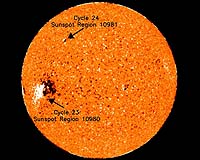
Bonn, Germany (SPX) Mar 25, 2009 The concept that a heavenly body such as the Sun should not be flawless: this sacrilegious idea bordered on blasphemy and got the natural scientist Galileo Galilei (1564-1642) into trouble with the Catholic church. However, he was not the first to concern himself with the dark areas on the Sun's surface. The black spots had already been described in antiquity. They had been systematically observed since the invention of the telescope at the beginning of the 17th century. The sunspots are caused by differences in temperature on the Sun's surface. Hot matter is continuously swirling out to the Sun's surface from its interior. This so-called convection can be inhibited by local increases in the Sun's magnetic field - this creates spots on the Sun's surface that are somewhat cooler and which then become visible as sunspots. 'Somewhat cooler' refers to the average surface temperature of around 6000 degrees Celsius. The core area of the spots (the umbra) is 'only' 4000 degrees Celsius, the peripheral area (the penumbra) is a good 5000 degrees Celsius. At these temperatures, the spots are also white hot, however the difference in temperature causes the light to be filtered and the spots appear black.
The number of sunspots fluctuates significantly At a sunspot maximum there can be hundreds of them. The spatial distribution of the spots across the Sun's surface and their magnetic orientation change during an 11-year cycle. Consequently, a complete sunspot cycle actually takes 22 years. At present, we are experiencing a minimum of solar activity that is lasting a surprisingly long time. The next maximum is expected in 2012. A glance at the website spaceweather.com shows how many sunspots exist at present. It can be exciting to make your own observations through a telescope. A suitable filter is absolutely vital, as viewing the Sun without protection can damage the eyes and lead to blindness. Share This Article With Planet Earth
Related Links German Aerospace Center Solar Science News at SpaceDaily
 New Sun-Watching Instrument To Monitor Sunlight Fluctuations
 Washington DC (SPX) Mar 24, 2009
During the Maunder Minimum, a period of diminished solar activity between 1645 and 1715, sunspots were rare on the face of the sun, sometimes disappearing entirely for months to years. At the same time, Earth experienced a bitter cold period known as the "Little Ice Age." |
|
|

| The content herein, unless otherwise known to be public domain, are Copyright 1995-2007 - SpaceDaily.AFP and UPI Wire Stories are copyright Agence France-Presse and United Press International. ESA Portal Reports are copyright European Space Agency. All NASA sourced material is public domain. Additional copyrights may apply in whole or part to other bona fide parties. Advertising does not imply endorsement,agreement or approval of any opinions, statements or information provided by SpaceDaily on any Web page published or hosted by SpaceDaily. Privacy Statement |
 del.icio.us
 Digg
Digg Reddit
 YahooMyWeb
 Google
 Facebook