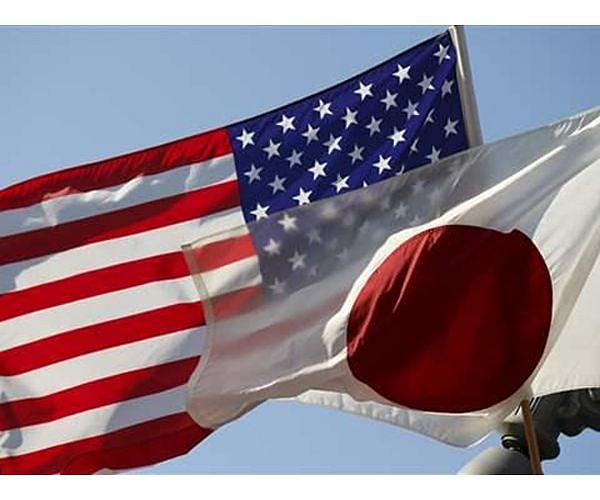
China on Wednesday accused the United States and Japan of colluding to interfere in its internal affairs after the two countries joined forces to warn of "destabilising behaviour" by Beijing in the region.
Beijing's response comes just a day before China's top diplomats are set to meet top US officials in Alaska in their first face-to-face talks since President Joe Biden's administration came to power.
But temperatures are rising ahead of the Alaska meet which will pit US Secretary of State Antony Blinken and White House national security adviser Jake Sullivan against senior Chinese official Yang Jiechi and Foreign Minister Wang Yi.
On Tuesday, US and Japanese foreign and defence ministers warned against "coercion and destabilising behaviour" by China in a joint statement after high level talks in Tokyo.
The comments from a nascent alliance that aims to hem in China's regional aspirations drew a swift rebuke.
"The US-Japan joint statement maliciously attacks China's foreign policy… and is an attempt to harm China's interests," Chinese foreign ministry spokesman Zhao Lijian told reporters on Wednesday.
He added that the two countries had "no right to unilaterally define international relations" or impose their own standards.
"This is just another clear example of the US and Japan working in collusion to interfere in China's internal affairs," said Zhao.
After their first stop in Japan, Pentagon chief Lloyd Austin and top diplomat Blinken arrived in Seoul on Wednesday as the Biden administration focuses on rallying alliances with its key Asian partners to counter a rising China.
US relations with China have plunged in recent years, and the upcoming Alaska talks will be the first between the powers since Yang met Blinken's hawkish predecessor Mike Pompeo last June in Hawaii.
The Biden administration has generally backed the tougher approach to China initiated by former president Donald Trump. But it has insisted it can be more effective by shoring up alliances and seeking narrow ways to cooperate on priorities such as climate change.
China says it is ready for a reset with Washngton following the turmoil of the Trump years, butM has warned the US and its allies to stay out of issues it perceives to be domestic concerns from Hong Kong to the treatment of Muslim Uighurs in Xinjiang.
Top US envoys in Seoul with China, North Korea on agenda
Seoul (AFP) March 17, 2021 –
Pentagon chief Lloyd Austin and top US diplomat Antony Blinken met their South Korean counterparts in Seoul on Wednesday to bolster a united front against an increasingly assertive China and the nuclear-armed North.
The South is the second leg of the US officials' inaugural overseas trip, and like their first stop, Japan, a leading security ally of the United States.
The Biden administration is focused on rallying alliances with its key Asian partners to counter a rising China.
Before leaving Tokyo, Secretary of State Blinken accused Beijing of acting more repressively at home and "more aggressively abroad", citing its activities in the East and South China Seas and towards Taiwan.
"It's important for us to make clear together that China cannot expect to act with impunity," Blinken said.
Beijing accused the United States and Japan of ganging up to interfere in its internal affairs and attempting to "harm China's interests".
"This is just another clear example of the US and Japan working in collusion to interfere in China's internal affairs," foreign ministry spokesman Zhao Lijian told reporters on Wednesday.
– 'Causing a stink' –
Austin also told South Korean defence minister Suh Wook that their alliance faced "unprecedented challenges posed by both the Democratic People's Republic of Korea and China".
North Korea is moving up the agenda in the South, where the US stations 28,500 troops to defend it against its neighbour.
The allies kicked off joint military exercises last week and North Korean leader Kim Jong Un's influential sister warned Washington this week against "causing a stink at its first step" if it wants to "sleep in peace for coming four years".
The statement by Kim Yo Jong, a key adviser to her brother, was the reclusive state's first explicit reference to the new leadership in Washington, more than four months after Joe Biden was elected to replace Donald Trump — although it still did not mention the 78-year-old Democrat by name.
The US envoys will meet on Thursday with President Moon Jae-in, who brokered the talks process between Kim and Trump in 2018.
– Policy review –
Trump's unorthodox approach to foreign policy saw him trade insults and threats of war with Kim Jong Un before an extraordinary diplomatic bromance that saw a series of headline-grabbing meetings.
But ultimately no progress was made towards Washington's declared aim of denuclearising North Korea, with a second summit in Hanoi in early 2019 breaking up without an agreement and Pyongyang still under multiple international sanctions for its banned weapons programmes.
Blinken and Austin will consult on a review of Washington's policy towards the North being carried out by the new administration.
But subtle differences between Washington and Seoul could be seen in their readouts of the defence chiefs' meeting Wednesday.
Pentagon press secretary John Kirby said Austin and Suh had expressed commitment to achieving "the denuclearisation of North Korea".
On the other hand Seoul's defence ministry said that they had "shared objectives of achieving the complete denuclearisation of the Korean peninsula and a permanent peace in the region".
The specific "North Korea" phrasing used by Washington is anathema to Pyongyang, which prefers the broader and more ambiguous reference to the peninsula as a whole, terminology that could be taken to include the US nuclear umbrella over the South.
The difference threatens to put Seoul on the horns of a diplomatic dilemma: since Hanoi, Moon's administration has repeatedly tried to reach out to Pyongyang but has been regularly rebuffed.