|
 |
 |
 |
 |
 |
 |
 |
 |
 |

| . |  |
. |
Coronet: A Star Formation Neighbor
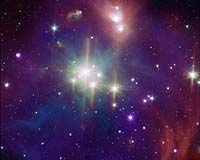
Pasadena CA (SPX) Sep 18, 2007 While perhaps not quite as well known as its star formation cousin of Orion, the Corona Australis region (containing, at its heart, the Coronet Cluster) is one of the nearest and most active regions of ongoing star formation. At only about 420 light years away, the Coronet is over three times closer than the Orion Nebula is to Earth. The Coronet contains a loose cluster of a few dozen young stars with a wide range of masses and at various stages of evolution, giving astronomers an opportunity to observe "protostars" simultaneously in several wavelengths. This composite image shows the Coronet in X-rays from Chandra (purple) and infrared emission from Spitzer (orange, green, and cyan). The Spitzer image shows young stars plus diffuse emission from dust. In the Chandra data only (see inset), many of these young stars appear as blue objects, revealing their output of high-energy X-rays and the amount of obscuring dust and gas in the region. The reason for the blue appearance is that lower energy X-rays, which are depicted as red and green, are absorbed by this veil of material and hence are not seen. The Chandra data also support the idea that X-rays from very young stars are generated largely from magnetic activity in the outer atmospheres. Due to the host of young stars in different life stages in the Coronet, astronomers can use these data to pinpoint details of how the youngest stars evolve. Community Email This Article Comment On This Article Related Links Chandra Stellar Chemistry, The Universe And All Within It
 Hubble Captures Stars Going Out In Style
 Washington DC (SPX) Sep 13, 2007
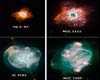
The colorful, intricate shapes in these NASA Hubble Space Telescope images reveal how the glowing gas ejected by dying Sun-like stars evolves dramatically over time. These gaseous clouds, called planetary nebulae, are created when stars in the last stages of life cast off their outer layers of material into space. Ultraviolet light from the remnant star makes the material glow. Planetary nebulae last for only 10,000 years, a fleeting episode in the 10-billion-year lifespan of Sun-like stars. |
|
|

| The content herein, unless otherwise known to be public domain, are Copyright 1995-2006 - SpaceDaily.AFP and UPI Wire Stories are copyright Agence France-Presse and United Press International. ESA PortalReports are copyright European Space Agency. All NASA sourced material is public domain. Additionalcopyrights may apply in whole or part to other bona fide parties. Advertising does not imply endorsement,agreement or approval of any opinions, statements or information provided by SpaceDaily on any Web page published or hosted by SpaceDaily. Privacy Statement |