|
 |
 |
 |
 |
 |
 |
 |
 |
 |

| . |  |
. |
Cortex Matures Faster In Youth With Highest IQ
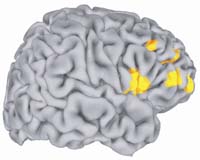
Bethesda MD (SPX) Mar 30, 2006 Youth with superior IQ are distinguished by how fast the thinking part of their brains thickens and thins as they grow up, researchers at the National Institutes of Health's (NIH) National Institute of Mental Health (NIMH) have discovered. Magnetic resonance imaging (MRI) scans showed that their brain's outer mantle, or cortex, thickens more rapidly during childhood, reaching its peak later than in their peers � perhaps reflecting a longer developmental window for high-level thinking circuitry. It also thins faster during the late teens, likely due to the withering of unused neural connections as the brain streamlines its operations. Drs. Philip Shaw, Judith Rapoport, Jay Giedd and colleagues at NIMH and McGill University report on their findings in the March 30, 2006 issue of Nature. "Studies of brains have taught us that people with higher IQs do not have larger brains. Thanks to brain imaging technology, we can now see that the difference may be in the way the brain develops," said NIH Director Elias A. Zerhouni, M.D. While most previous MRI studies of brain development compared data from different children at different ages, the NIMH study sought to control for individual variation in brain structure by following the same 307 children and teens, ages 5-19, as they grew up. Most were scanned two or more times, at two-year intervals. The resulting scans were divided into three equal groups and analyzed based on IQ test scores: superior (121-145), high (109-120), and average (83-108). The researchers found that the relationship between cortex thickness and IQ varied with age, particularly in the prefrontal cortex, seat of abstract reasoning, planning, and other "executive" functions. The smartest 7-year-olds tended to start out with a relatively thinner cortex that thickened rapidly, peaking by age 11 or 12 before thinning. In their peers with average IQ, an initially thicker cortex peaked by age 8, with gradual thinning thereafter. Those in the high range showed an intermediate trajectory (see below). While the cortex was thinning in all groups by the teen years, the superior group showed the highest rates of change. "Brainy children are not cleverer solely by virtue of having more or less gray matter at any one age," explained Rapoport. "Rather, IQ is related to the dynamics of cortex maturation." The observed differences are consistent with findings from functional magnetic resonance imaging, showing that levels of activation in prefrontal areas correlates with IQ, note the researchers. They suggest that the prolonged thickening of prefrontal cortex in children with superior IQs might reflect an "extended critical period for development of high-level cognitive circuits." Although it's not known for certain what underlies the thinning phase, evidence suggests it likely reflects "use-it-or-lose-it" pruning of brain cells, neurons, and their connections as the brain matures and becomes more efficient during the teen years. "People with very agile minds tend to have a very agile cortex," said Shaw. The NIMH researchers are following-up with a search for gene variants that might be linked to the newly discovered trajectories. However, Shaw notes mounting evidence suggesting that the effects of genes often depends on interactions with environmental events, so the determinants of intelligence will likely prove to be a very complex mix of nature and nurture. Also participating in the study were Drs. Dede Greenstein, Liv Clasen, Rhoshel Lenroot, and Nitin Gogtay, Child Psychiatry Branch, NIMH; and Drs. Jason Lerch and Alan Evans, Montreal Neurological Institute, McGill University. Related Links NIH/National Institute of Mental Health  New Light On Muscle Efficiency
 Odense, Denmark (SPX) Mar 28, 2006
A recent study from Scandinavia shows that the well-known differences between individuals in the efficiency of converting energy stored in food to work done by muscles are related to muscle fibre type composition and to the content of specific molecules in muscle. When muscles contract they use energy that is derived from food. |
|
|

| The content herein, unless otherwise known to be public domain, are Copyright 1995-2006 - SpaceDaily.AFP and UPI Wire Stories are copyright Agence France-Presse and United Press International. ESA PortalReports are copyright European Space Agency. All NASA sourced material is public domain. Additionalcopyrights may apply in whole or part to other bona fide parties. Advertising does not imply endorsement,agreement or approval of any opinions, statements or information provided by SpaceDaily on any Web page published or hosted by SpaceDaily. Privacy Statement |