|
 |
 |
 |
 |
 |
 |
 |
 |
 |

| . |  |
. |
Getting Closer To The Lord Of The Rings
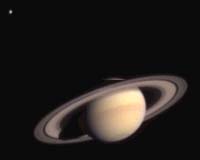
Paris - Jan 21, 2004 This time next year, ESA's Huygens spaceprobe will be descending through the atmosphere of Saturn's largest moon, becoming the first spacecraft to land on a body in the outer Solar System. Earlier this month, the giant ringed planet Saturn was closer to Earth than it will be for the next thirty years. All the planets orbit the Sun as if on a giant racetrack, travelling in the same direction but in different lanes. Those in the outer lanes have further to travel than those on the inside lanes. So, Earth regularly 'laps' the further planets. On New Year's Eve 2003, Earth overtook Saturn, drawing closer than at any time in the next three decades. Through a small telescope, Saturn is normally visible as a creamy yellow 'star'. You may be able to see the ring system that the planet is famous for, and its largest moon Titan will show up as a tiny dot of light. That tiny dot is the destination for ESA's Huygens probe and may hold vital clues about how life began on Earth. Titan is the only moon with a thick atmosphere in the Solar System. Astronomers think this atmosphere might closely match the one Earth possessed millions of years ago, before life began. Certainly Titan's atmosphere is rich in carbon, the chemical necessary for life on Earth. What is more, this is all stored in 'deep freeze', ten times further from the Sun than the Earth. The big mystery is Titan's surface, which is hidden by a cloud layer. This is why ESA built Huygens, to probe through this layer which is impenetrable by Earth-based observations. In January 2005, Huygens will parachute below the clouds to see what is really going on. Its battery of instruments will return over 1000 images as it floats down and samples the chemistry of this exotic place. The Titan probe was named Huygens in honour of the Dutch astronomer who discovered Titan in 1655. Launched in October 1997, Huygens is currently in space, hitching a ride on NASA's Cassini spacecraft. So look forward to seeing more of Saturn and a tiny European spacecraft called Huygens, that in one year's time will make an historic landing in the quest to uncover the origins of life. Related Links Huygens at ESA Cassini at JPL SpaceDaily Search SpaceDaily Subscribe To SpaceDaily Express  First Detection Of CO In Uranus
 Paris - Dec 18, 2003
A team from Paris Observatory, led by Th�r�se Encrenaz (LESIA), has just detected for the first time the molecule of carbon monoxide (CO) in the atmosphere of Uranus. The origin of this molecule is probably external to the planet, for example due to micrometeorites. |
|
|

| The content herein, unless otherwise known to be public domain, are Copyright 1995-2006 - SpaceDaily.AFP and UPI Wire Stories are copyright Agence France-Presse and United Press International. ESA PortalReports are copyright European Space Agency. All NASA sourced material is public domain. Additionalcopyrights may apply in whole or part to other bona fide parties. Advertising does not imply endorsement,agreement or approval of any opinions, statements or information provided by SpaceDaily on any Web page published or hosted by SpaceDaily. Privacy Statement |