
 |
 |
 |
 |
 |
 |
 |
 |
 |
 |

| . |  |
. |
LHC Switch-On Fears Are Completely Unfounded
Washington DC (SPX) Sep 08, 2008 A new report published on Friday, 5 September, provides the most comprehensive evidence available to confirm that the Large Hadron Collider (LHC)'s switch-on, due on Wednesday next week, poses no threat to mankind. Nature's own cosmic rays regularly produce more powerful particle collisions than those planned within the LHC, which will enable nature's laws to be studied in controlled experiments. The LHC Safety Assessment Group have reviewed and updated a study first completed in 2003, which dispels fears of universe-gobbling black holes and of other possibly dangerous new forms of matter, and confirms that the switch-on will be completely safe. The report, 'Review of the Safety of LHC Collisions', published in IOP Publishing's Journal of Physics G: Nuclear and Particle Physics, proves that if particle collisions at the LHC had the power to destroy the Earth, we would never have been given the chance to exist, because regular interactions with more energetic cosmic rays would already have destroyed the Earth or other astronomical bodies. The Safety Assessment Group writes, "Nature has already conducted the equivalent of about a hundred thousand LHC experimental programmes on Earth - and the planet still exists." The Safety Assessment Group compares the rates of cosmic rays that bombard Earth, other planets in our solar system, the Sun and all the other stars in our universe itself to show that hypothetical black holes or strangelets, that have raised fears in some, will in fact pose no threat. The report also concludes that, since cosmic-ray collisions are more energetic than those in the LHC, but are incapable of producing vacuum bubbles or dangerous magnetic monopoles, we should not fear their creation by the LHC. LHC collisions will differ from cosmic-ray collisions in that any exotic particles created will have lower velocities, but the Safety Assessment Group shows that even fast-moving black holes produced by cosmic rays would have stopped inside the Earth or other astronomical bodies. Their existence proves that any such black holes could not gobble matter at a risky rate. As the Safety Assessment Group writes, "Each collision of a pair of protons in the LHC will release an amount of energy comparable to that of two colliding mosquitoes, so any black hole produced would be much smaller than those known to astrophysicists." They conclude that such microscopic black holes could not grow dangerously. As for the equally hypothetical strangelets, the review uses recent experimental measurements at the Brookhaven National Laboratory's Relativistic Heavy-Ion Collider, New York, to prove that they will not be produced during collisions in the LHC. Community Email This Article Comment On This Article Share This Article With Planet Earth
Related Links Institute of Physics Understanding Time and Space
 Electron Trapping Within Reconnection
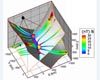 Paris, France (ESA) Aug 13, 2008
A 3-dimensional (3-D) "magnetic snapshot" of the heart of a magnetic reconnection region has been obtained in-situ by the four satellites of the ESA Cluster mission, at one-third of the distance to the Moon from Earth. |
|
|

| The content herein, unless otherwise known to be public domain, are Copyright 1995-2007 - SpaceDaily.AFP and UPI Wire Stories are copyright Agence France-Presse and United Press International. ESA Portal Reports are copyright European Space Agency. All NASA sourced material is public domain. Additional copyrights may apply in whole or part to other bona fide parties. Advertising does not imply endorsement,agreement or approval of any opinions, statements or information provided by SpaceDaily on any Web page published or hosted by SpaceDaily. Privacy Statement |
 del.icio.us
 Digg
Digg Reddit
 YahooMyWeb
 Google
 Facebook