|
 |
 |
 |
 |
 |
 |
 |
 |
 |

| . |  |
. |
'Orphan' Stars Found In Long Galaxy Tail
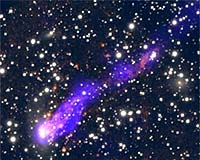
Huntsville AL (SPX) Sep 21, 2007 Astronomers have found evidence that stars have been forming in a long tail of gas that extends well outside its parent galaxy. This discovery suggests that such "orphan" stars may be much more prevalent than previously thought. The comet-like tail was observed in X-ray light with NASA's Chandra X-ray Observatory and in optical light with the Southern Astrophysical Research (SOAR) telescope in Chile. The feature extends for more than 200,000 light years and was created as gas was stripped from a galaxy called ESO 137-001 that is plunging toward the center of Abell 3627, a giant cluster of galaxies. "This is one of the longest tails like this we have ever seen," said Ming Sun of Michigan State University, who led the study. "And, it turns out that this is a giant wake of creation, not of destruction." The observations indicate that the gas in the tail has formed millions of stars. Because the large amounts of gas and dust needed to form stars are typically found only within galaxies, astronomers have previously thought it unlikely that large numbers of stars would form outside a galaxy. "This isn't the first time that stars have been seen to form between galaxies," said team member Megan Donahue, also of MSU. "But the number of stars forming here is unprecedented." The evidence for star formation in this tail includes 29 regions of ionized hydrogen glowing in optical light, thought to be from newly formed stars. These regions are all downstream of the galaxy, located in or near the tail. Two Chandra X-ray sources are near these regions, another indication of star formation activity. The researchers believe the orphan stars formed within the last 10 million years or so. The stars in the tail of this fast-moving galaxy, which is some 220 million light years away, would be much more isolated than the vast majority of stars in galaxies. "By our galactic standards, these are extremely lonely stars," said Mark Voit, another team member from MSU. "If life was to form out there on a planet a few billion years from now, they would have very dark skies." The gas that formed the orphan stars was stripped out of its parent galaxy by the pressure induced by the motion of the galaxy through the multimillion degree gas that pervades the intergalactic space of the galaxy cluster. Eventually most of the gas will be scoured from the galaxy, depleting the raw material for new stars, and effectively stopping further star formation in the galaxy. This process may represent an important but short-lived stage in the transformation of a galaxy. Although apparently rare in the present-day universe, galactic tails of gas and orphan stars may have been more common billions of years ago when galaxies were younger and richer in star-forming gas. These results will appear in the December 10th issue of The Astrophysical Journal. NASA's Marshall Space Flight Center, Huntsville, Ala., manages the Chandra program for the agency's Science Mission Directorate. The Smithsonian Astrophysical Observatory controls science and flight operations from the Chandra X-ray Center in Cambridge, Mass. Community Email This Article Comment On This Article Related Links Stellar Chemistry, The Universe And All Within It
 The Magellanic Clouds Are First-Time Visitors
 Cambridge MA (SPX) Sep 20, 2007
The Large Magellanic Cloud (LMC) and Small Magellanic Cloud (SMC) are two of the Milky Way's closest neighboring galaxies. A stunning sight in the southern hemisphere, they were named after Ferdinand Magellan, who explored those waters in the 16th century. For hundreds of years, these galaxies were considered satellites of the Milky Way, gravitationally bound to our home galaxy. New research by Gurtina Besla (Harvard-Smithsonian Center for Astrophysics) and her colleagues shows that the Magellanic Clouds are recent arrivals on their first visit to the Milky Way's neighborhood. |
|
|

| The content herein, unless otherwise known to be public domain, are Copyright 1995-2006 - SpaceDaily.AFP and UPI Wire Stories are copyright Agence France-Presse and United Press International. ESA PortalReports are copyright European Space Agency. All NASA sourced material is public domain. Additionalcopyrights may apply in whole or part to other bona fide parties. Advertising does not imply endorsement,agreement or approval of any opinions, statements or information provided by SpaceDaily on any Web page published or hosted by SpaceDaily. Privacy Statement |