|
 |
 |
 |
 |
 |
 |
 |
 |
 |

| . |  |
. |
Pluto's Moon - Rare Alignment Seen
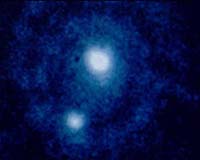
Cambridge MA (SPX) Jul 20, 2005 In a feat of astronomical and terrestrial alignment, a group of scientists from MIT and Williams College recently succeeded in observing distant Pluto's tiny moon, Charon, hide a star. Such an event had been seen only once before, by a single telescope 25 years ago, and then not nearly as well. The MIT-Williams consortium spotted it with four telescopes in Chile on the night of July 10-11. In addition to assessing whether Charon has an atmosphere, the team expects to get a new, accurate value for Charon's radius and determine how round it is. The team had more than 100 square meters (about 1,000 square feet) of telescope surface facing Charon, Pluto and the star beyond them-a noticeable fraction of the world's total telescope area. The data and results from the recent observation will be presented at the 2005 meeting of the American Astronomical Society's Division of Planetary Sciences meeting to be held in Cambridge, England, in September. MIT team leader James L. Elliot headed the group at the Clay Telescope at Las Campanas Observatory in Chile. "We have been waiting many years for this opportunity. Watching Charon approach the star and then snuff it out was spectacular," said Elliot, a professor in MIT's Department of Earth, Atmospheric and Planetary Science and in the Department of Physics. Jay M. Pasachoff, Williams College team leader and a professor in the Department of Astronomy, said, "It's amazing that people in our group could get in the right place at the right time to line up a tiny body 4 billion miles away. It's quite a reward for so many people who worked so hard to arrange and integrate the equipment and to get the observations." With the Clay Telescope's 6.5-meter mirror (more than 21 feet across, the size of a large room) the researchers were able to observe changes in fractional seconds throughout the event, which lasted less than a minute. While their electronic cameras sensitively recorded data, the light of the faint star was seen to dim and then, some seconds later, brighten. This kind of disappearance of a celestial body behind a closer, apparently larger one is known as an occultation. From just how the light dimmed and brightened, the MIT-Williams consortium will look for signs that Charon has an atmosphere. It has very little mass, so has little gravity to hold in an atmosphere, but it is so cold (being some 40 times farther from the sun than the Earth, and thus about 4 billion miles away) that some gases could be held in place by the small amount of Charon's gravity. The group had previously investigated Pluto's atmosphere and found a slight global warming there. They had earlier found a similar warming of the atmosphere of Neptune's moon Triton, which is an analogue of Pluto. Other telescopes around Chile used by the MIT-Williams consortium included the 8-meter (more than 26 feet across) Gemini South on Cerro Pachon, the 2. 5-meter (over 8 feet across) DuPont Telescope at Las Campanas Observatory, and the 0.8-meter (almost 3 feet across)) telescope at the Cerro Armazones Observatory of Chile's Catholic University of the North near Cerro Paranal. The team had searched for a distribution of telescopes along a north-south line in Chile since the predictions of the starlight shadow of Charon were uncertain by several hundred kilometers. Since the star that was hidden is so far away, it casts a shadow of Charon that is the same size as Charon itself, about 1,200 kilometers in diameter. To see the event, the distant star, Charon, and the telescopes in Chile had to be perfectly aligned. All these telescopes were in clear weather and successfully observed the occultation. At Las Campanas Elliot and MIT graduate student Elisabeth Adams observed with the Clay Telescope, while Amanda Gulbis, a postdoctoral associate at MIT, and David Osip of the Carnegie Institution of Washington observed with the DuPont Telescope. Williams College scientist Bryce Babcock and Williams undergraduate Joseph Gangestad, joined by MIT graduate student Michael Person, observed with the telescope of Cerro Armazones Observatory in Chile's Atacama Desert, the telescope that was farthest north. MIT graduate student Susan Kern supervised the observations taken with the giant 8-meter Gemini South project on Cerro Pachon, the southernmost of the telescopes. Pasachoff and Williams instrument scientist Steven Souza were at a 0. 6-meter telescope at the Brazilian National Observatory, Pico dos Dias, northeast of S�o Paulo. They were joined by Professor Marcelo Emilio of Brazil's Ponta Grossa State University and his undergraduate student Caroline Czelusniak. However, clouds foiled their observing. The images from three telescopes in Chile, including the Clay Telescope, and one in Brazil, were taken with new electronic cameras and computer control obtained by MIT and Williams with an equipment grant from NASA. The expeditions were sponsored by NASA's Planetary Astronomy Program. A video showing the star dimming as Charon passes in front of it and then brightening again is posted on the Web. Teams from the Observatory of Paris at Meudon and from the Southwest Research Institute in Boulder, Colo., also observed the occultation. Related LinksSpaceDaily Search SpaceDaily Subscribe To SpaceDaily Express  Pluto Bound Spacecraft Shipped To Goddard For Pre-launch Tests
 Greenbelt MD (SPX) Jun 14, 2005
The first spacecraft designed to study Pluto, the solar system's farthest planet, took the first steps on a long journey today when it was shipped from the Johns Hopkins University Applied Physics Laboratory (APL) in Laurel, Md. - where it was designed and built - to NASA's Goddard Space Flight Center for its next round of pre-launch tests. |
|
|

| The content herein, unless otherwise known to be public domain, are Copyright 1995-2006 - SpaceDaily.AFP and UPI Wire Stories are copyright Agence France-Presse and United Press International. ESA PortalReports are copyright European Space Agency. All NASA sourced material is public domain. Additionalcopyrights may apply in whole or part to other bona fide parties. Advertising does not imply endorsement,agreement or approval of any opinions, statements or information provided by SpaceDaily on any Web page published or hosted by SpaceDaily. Privacy Statement |