|
 |
 |
 |
 |
 |
 |
 |
 |
 |

| . |  |
. |
The Colorful Lives Of The Outer Planets
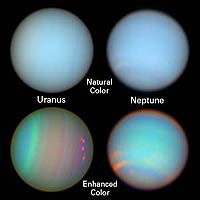
Baltimore - Jan 27, 2004 Atmospheric features on Uranus and Neptune are revealed in images taken with the Space Telescope Imaging Spectrograph and the Advanced Camera for Surveys aboard NASA's Hubble Space Telescope. A wider view of Uranus reveals the planet's faint rings and several of its satellites. The observations were taken in August 2003.
Uranus and Neptune: At first glance, the top row of images makes the planets appear like twins. But the bottom row reveals that Uranus and Neptune are two different worlds. Uranus's rotational axis, for example, is tilted almost 90 degrees to Neptune's axis. The south poles of Uranus and Neptune are at the left and bottom, respectively. Both are tilted slightly toward Earth. Uranus also displays more contrast between both hemispheres. This may be caused by its extreme seasons. Both planets display a banding structure of clouds and hazes aligned parallel to the equator. Additionally, a few discrete cloud features appear bright orange or red. The color is due to methane absorption in the red part of the spectrum. Methane is third in abundance in the atmospheres of Uranus and Neptune after hydrogen and helium, which are both transparent. Colors in the bands correspond to variations in the altitude and thickness of hazes and clouds. The colors allow scientists to measure the altitudes of clouds from far away.
Uranus (A Wider View): The bright satellite on the lower right corner is Ariel, which has a snowy white surface. Five small satellites with dark surfaces can be seen just outside the rings. Clockwise from the top, they are: Desdemona, Belinda, Portia, Cressida, and Puck. Even fainter satellites were imaged in deeper exposures, also taken with the Advanced Camera in August 2003. Related Links Hubble SpaceDaily Search SpaceDaily Subscribe To SpaceDaily Express  Getting Closer To The Lord Of The Rings
 Paris - Jan 21, 2004
This time next year, ESA's Huygens spaceprobe will be descending through the atmosphere of Saturn's largest moon, becoming the first spacecraft to land on a body in the outer Solar System.
--------------------------------------------------------- It's new. And it's downright terrific! Celestron's CPC Schmidt-Cassegrain telescope is the scope you've been waiting for! It offers new alignment technology, advanced engineering, and bold new design at a new, low price! In fact, Celestron's Professional Computerized (CPC) scope with revolutionary SkyAlign Alignment Technology redefines everything that amateur astronomers are looking for. It offers quick and simple alignment, GPS technology, unsurpassed optical quality, ease of use, advanced ergonomics, enhanced computerization and, most important, affordability. Want to view M-31 tonight? One button takes you there!
Shop for telescopes online at Telescopes.com! today!
|
|
|

| The content herein, unless otherwise known to be public domain, are Copyright 1995-2006 - SpaceDaily.AFP and UPI Wire Stories are copyright Agence France-Presse and United Press International. ESA PortalReports are copyright European Space Agency. All NASA sourced material is public domain. Additionalcopyrights may apply in whole or part to other bona fide parties. Advertising does not imply endorsement,agreement or approval of any opinions, statements or information provided by SpaceDaily on any Web page published or hosted by SpaceDaily. Privacy Statement |