|
 |
 |
 |
 |
 |
 |
 |
 |
 |

| . |  |
. |
USSR misjudged importance of Sputnik satellite: Krushchev's son
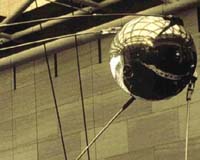
Washington (AFP) Oct 2, 2007 The Soviet Union did not immediately grasp the importance of its Sputnik satellite after launching it 50 years ago, triggering a space race with the United States, said the son of then USSR leader Nikita Krushchev. "The consequences became clear much later. At the time it was like sending a ball far away," Sergei Krushchev, an expert on Russia at Brown University in Rhode Island, told a forum on the 50th anniversary of the Sputnik's launch on Monday. On October 4, 1957, the shiny, 58-centimeter (23-inch) spherical satellite beamed its now famous distorted beeps back to earth, announcing the start of man's conquest of space. The next day, the official Soviet newspaper Pravda gave Sputnik a few lines. The space launch was at first perceived as just another breakthrough in Soviet technology, said the son of Krushchev, who ruled from 1953-1964. "It was proving that we were on the right road" technologically, he said. For the United States, instead, Sputnik boosted awareness about the challenge of space at the height of the Cold War, Sergei Krushchev said. "It was a wakeup call for the US," he said. "All threats are creating this paranoia that can be used in a positive or negative way. The fear after Sputnik was used in a positive way, with consequences on education." In its effort to win the space race, the United States revised academic programs and increased funding for the study of science and a presidential advisor for sciences was appointed. Eventually, in July 1958, the National Aeronautics and Space Administration (NASA) came into being. "It was no space race with the USSR, it was an American race with itself," Sergei Kruschchev said. "The real race was when (Leonid) Brezhnev came to power" in 1964, he added. And the space race continues to this very day, Sergei said: "America will go to Mars because they want to prove themselves that they can do it before the Chinese." According to US experts who took part in the forum, the United States was shocked and inspired by the USSR's success with Sputnik. "America had always thought we were first in everything. Russia led us with the first satellite, there was a lot of concern about that," said historian Roger Launius, of the Smithsonian Institution's National Air and Space Museum. "We couldn't believe the Russians had put an object in space," said Thomas Stafford, a former NASA astronaut co-leader of the first US-Soviet, Apollo-Soyuz space flight in 1975. "A response so dramatic doesn't happen too often," he said about the late US president John F. Kennedy's pledge in 1961 to put a man on the moon before the the end of the decade. "I don't think we would have accomplished so much in such a period of time," Staffort said. "Sputnik pushed education in ... science and technology in schools and universities," he added. Community Email This Article Comment On This Article Related Links Station and More at Roscosmos S.P. Korolev RSC Energia Russian Space News
 50 years after Sputnik, Russia revives space ambitions
 Moscow (AFP) Sept 30, 2007
Russia's space machines may have a clunky look but they are reliable and today these workhorses are underpinning a revival of Moscow's ambitions after the financial collapse of the 1990s. |
|
|

| The content herein, unless otherwise known to be public domain, are Copyright 1995-2006 - SpaceDaily.AFP and UPI Wire Stories are copyright Agence France-Presse and United Press International. ESA PortalReports are copyright European Space Agency. All NASA sourced material is public domain. Additionalcopyrights may apply in whole or part to other bona fide parties. Advertising does not imply endorsement,agreement or approval of any opinions, statements or information provided by SpaceDaily on any Web page published or hosted by SpaceDaily. Privacy Statement |