|
 |
 |
 |
 |
 |
 |
 |
 |
 |

| . |  |
. |
Chandra Catches Piranha Black Holes
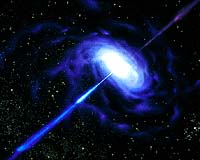
Cambridge, MA (SPX) Jul 25, 2007 Supermassive black holes have been discovered to grow more rapidly in young galaxy clusters, according to new results from NASA's Chandra X-ray Observatory. These "fast-track" supermassive black holes can have a big influence on the galaxies and clusters that they live in. Using Chandra, scientists surveyed a sample of clusters and counted the fraction of galaxies with rapidly growing supermassive black holes, known as active galactic nuclei (or AGN). The data show, for the first time, that younger, more distant galaxy clusters contained far more AGN than older, nearby ones. Galaxy clusters are some of the largest structures in the Universe, consisting of many individual galaxies, a few of which contain AGN. Earlier in the history of the universe, these galaxies contained a lot more gas for star formation and black hole growth than galaxies in clusters do today. This fuel allows the young cluster black holes to grow much more rapidly than their counterparts in nearby clusters. "The black holes in these early clusters are like piranha in a very well-fed aquarium," said Jason Eastman of Ohio State University (OSU) and first author of this study. "It's not that they beat out each other for food, rather there was so much that all of the piranha were able to really thrive and grow quickly." The team used Chandra to determine the fraction of AGN in four different galaxy clusters at large distances, when the Universe was about 58% of its current age. Then they compared this value to the fraction found in more nearby clusters, those about 82% of the Universe's current age. The result was the more distant clusters contained about 20 times more AGN than the less distant sample. AGN outside clusters are also more common when the Universe is younger, but only by factors of two or three over the same age span. "It's been predicted that there would be fast-track black holes in clusters, but we never had good evidence until now," said co-author Paul Martini, also of OSU. "This can help solve a couple of mysteries about galaxy clusters." One mystery is why there are so many blue, star-forming galaxies in young, distant clusters and fewer in nearby, older clusters. AGN are believed to expel or destroy cool gas in their host galaxy through powerful eruptions from the black hole. This may stifle star formation and the blue, massive stars will then gradually die off, leaving behind only the old, redder stars. This process takes about a billion years or more to take place, so a dearth of star-forming galaxies is only noticeable for older clusters. The process that sets the temperature of the hot gas in clusters when they form is also an open question. These new results suggest that even more AGN may have been present when most clusters were forming about ten billion years ago. Early heating of a cluster by large numbers of AGN can have a significant, long-lasting effect on the structure of a cluster by "puffing up" the gas. "In a few nearby clusters we've seen evidence for huge eruptions generated by supermassive black holes. But this is sedate compared to what might be going on in younger clusters," said Eastman. These results appeared in the July 20th issue of The Astrophysical Journal Letters. NASA's Marshall Space Flight Center, Huntsville, Ala., manages the Chandra program for the agency's Science Mission Directorate. The Smithsonian Astrophysical Observatory controls science and flight operations from the Chandra X-ray Center in Cambridge, Mass. Community Email This Article Comment On This Article Related Links Chandra at NASA Chandra at Harvard Understanding Time and Space
 Neutron Stars Join The Black Hole Jet Set
 Cambridge, MA (SPX) Jun 29, 2007
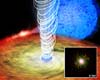
NASA's Chandra X-ray Observatory has revealed an X-ray jet blasting away from a neutron star in a binary system. This discovery may help astronomers understand how neutron stars as well as black holes can generate powerful beams of relativistic particles. The jet was found in Circinus X-1, a system where a neutron star is in orbit around a star several times the mass of the Sun, about 20,000 light years from Earth. A neutron star is an extremely dense remnant of an exploded star consisting of tightly packed neutrons. |
|
|

| The content herein, unless otherwise known to be public domain, are Copyright 1995-2006 - SpaceDaily.AFP and UPI Wire Stories are copyright Agence France-Presse and United Press International. ESA PortalReports are copyright European Space Agency. All NASA sourced material is public domain. Additionalcopyrights may apply in whole or part to other bona fide parties. Advertising does not imply endorsement,agreement or approval of any opinions, statements or information provided by SpaceDaily on any Web page published or hosted by SpaceDaily. Privacy Statement |