
 |
 |
 |
 |
 |
 |
 |
 |
 |
 |

| . |  |
. |
Michigan Integral To World's Largest Physics Experiment
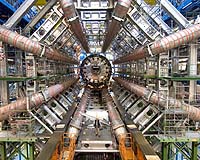
Ann Arbor MI (SPX) Sep 09, 2008 After 20 years of construction, a machine that could either verify or nullify the prevailing theory of particle physics is about to begin its mission. CERN's epic Large Hadron Collider (LHC) project currently involves 25 University of Michigan physicists and students. More than 100 U-M researchers have been involved in the project over the years. CERN is the European Organization for Nuclear Research, located in Geneva, Switzerland. The historic multibillion-dollar project aims to answer lingering questions about the laws of nature and the nature of matter by smashing protons and other particles together and examining the wreckage. The collider-the world's largest-is scheduled to send the first proton beam zipping through its 17-mile tunnel on Sept. 10. Scientists expect it will take four to eight weeks to adjust the beams to produce particle collisions. They hope to observe the first collisions between Oct. 8 and Nov. 5. "The Large Hadron Collider should address some of the most fundamental questions facing science now," said Homer Neal, the Samuel A. Goudsmit Professor of Physics and the U-M Institutional Representative for the ATLAS Experiment at the LHC. "This is an extremely exciting time to be involved with the project and with so many bright and dedicated faculty colleagues and sharp post-docs and students. It's been a long wait." ATLAS is one of the two large particle detectors on the collider. Michigan physicists and students helped design and build it. ATLAS and CMS, the other large particle detector, are looking for the same new particles, but in different ways. They back each other up, but they also will compete. Neal has been working at CERN periodically for 40 years. He was also on the board of overseers of the Superconducting Super Collider project in Texas that was scrapped in 1993 in the early stages of construction. "Many of us who have been eager to search for the Higgs boson and to explore other particles have been waiting not just during the period we've been working on the CERN LHC, but even before then, as we watched the Texas project undergo years of planning and then crumble," Neal said. The Higgs boson particle is perhaps the most sought-after prize of the project. The Standard Model of particle physics theorizes that it gives other particles mass. This theory says the Higgs creates a field that particles with mass interact with. Particles without mass don't interact with this field. The Higgs should be detectable at the energies the collider is capable of producing. If scientists find it, their Standard Model survives. "If it does not exist," Neal said, "we'll clearly have to go back to the drawing board. That would shake the foundation of how we believe the smallest components of matter interact with each other and how mass itself is created. But even this outcome would be extremely exciting and would launch new avenues of exploration." The Standard Model attempts to unify the forces of nature. Since its inception in the 1970s it has accurately predicted experimental results. But the role of the Higgs in generating mass has not yet been confirmed. The origin of mass remains a mystery. Furthermore, the Standard Model doesn't explain the existence of the dark matter and dark energy that scientists believe makes up 96 percent of the universe. The collider will, in essence, recreate the conditions of the earliest universe.It will tear apart particles so physicists can study their components and observe as the particles put themselves back together. Michigan researchers built components of ATLAS called muon detectors that Bing Zhou, professor in the U-M Physics Department says should play a lead role in finding the Higgs. "These muon detectors will have the best chance of finding the signal for decay of the Higgs boson through the muon final states," said Zhou, who is leader of U.S. ATLAS muon detector development and construction. U-M researchers are involved in several experiments as well. In addition to searching for the Higgs boson, they will hunt for evidence of supersymmetry, a theory that all currently known particles have a heavier shadow particle called a superpartner. Supersymmetric particles are one candidate for dark matter and dark energy. U-M experimenters will also examine how high energy collisions affect particle spin, another fundamental quantum property with a broad impact on the structure of matter. Community Email This Article Comment On This Article Share This Article With Planet Earth
Related Links CERN University of Michigan Understanding Time and Space
 LHC Switch-On Fears Are Completely Unfounded
 Washington DC (SPX) Sep 08, 2008
A new report published on Friday, 5 September, provides the most comprehensive evidence available to confirm that the Large Hadron Collider (LHC)'s switch-on, due on Wednesday next week, poses no threat to mankind. Nature's own cosmic rays regularly produce more powerful particle collisions than those planned within the LHC, which will enable nature's laws to be studied in controlled experiments. |
|
|

| The content herein, unless otherwise known to be public domain, are Copyright 1995-2007 - SpaceDaily.AFP and UPI Wire Stories are copyright Agence France-Presse and United Press International. ESA Portal Reports are copyright European Space Agency. All NASA sourced material is public domain. Additional copyrights may apply in whole or part to other bona fide parties. Advertising does not imply endorsement,agreement or approval of any opinions, statements or information provided by SpaceDaily on any Web page published or hosted by SpaceDaily. Privacy Statement |
 del.icio.us
 Digg
Digg Reddit
 YahooMyWeb
 Google
 Facebook