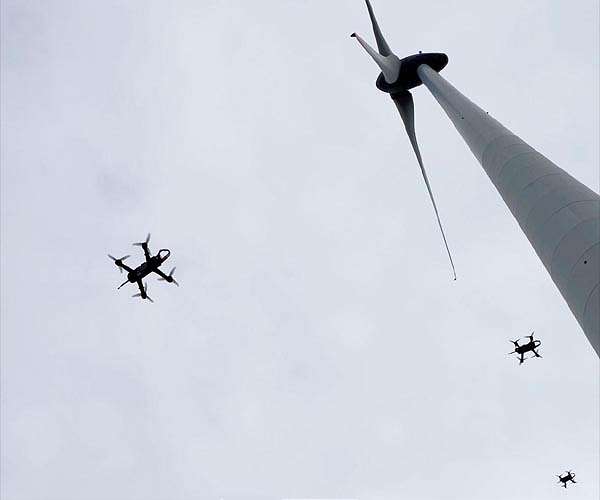
UAV swarms are increasingly used for missions such as disaster assessment and reconnaissance, but their reliance on open wireless links exposes them to interference and eavesdropping in contested environments. Traditional spectrum allocation schemes often assume complete and accurate channel and interference information, an assumption that rarely holds when signal conditions change quickly and external emitters are only partially observed.
A research team led by Professor Lin at Harbin Engineering University has proposed an intelligent decision framework to manage UAV swarm spectrum resources under incomplete interference information. The work, published in the Chinese Journal of Aeronautics, combines fuzzy logic, dynamic constrained multi-objective optimization, and transfer learning to support autonomous spectrum allocation when the environment is uncertain and time-varying.
The framework uses fuzzy logic to describe external interference without requiring precise measurements. Interference intensity, range, and spatial distance are represented through fuzzy sets, membership functions, and inference rules, allowing the system to convert vague perceptions of the electromagnetic environment into real-time spectrum constraints that update as conditions change. This process turns incomplete and qualitative interference assessments into operational inputs for decision-making during iterative optimization.
At its core, the method formulates a dynamic constrained multi-objective optimization problem that simultaneously addresses communication performance and security. The model seeks to reduce self-interference within the swarm and limit the throughput achievable by potential eavesdroppers, while meeting constraints related to spectrum utilization, frequency conflicts, and minimum communication quality requirements. This multi-objective formulation yields trade-off solutions that maintain reliable intra-swarm links and restrict information leakage, even in complex adversarial environments.
To adapt quickly when the interference landscape changes, the team designed a Transfer Search-based Dynamic Constrained Multi-Objective Evolutionary Algorithm (TrS-DCMOEA). Instead of restarting the search whenever the environment shifts, TrS-DCMOEA applies transfer learning to map previously obtained optimal or near-optimal solutions into a latent space and then into the new environment, generating high-quality initial populations for the updated optimization run. This reuse of historical knowledge accelerates convergence and supports real-time or near-real-time decision updates for the swarm.
The researchers report that this combination of fuzzy modeling and transfer-enhanced dynamic optimization enables UAV swarms to maintain effective communication and security despite incomplete and evolving interference information. The framework addresses a key obstacle for large-scale autonomous swarm deployment in contested spectrum, offering a structured approach for systems developers working on UAV communication networks.
Future work by Professor Lin's group will expand the framework to larger swarm sizes and more complex resource domains. Planned extensions include joint optimization of spectrum, computation, and storage resources, with the aim of providing technical support for UAV swarms operating in low-altitude economic applications and in integrated space-air-ground 6G network architectures.
Research Report:Dynamic decision-making of UAV swarm based on constrained multi-objective optimization under incomplete interference information