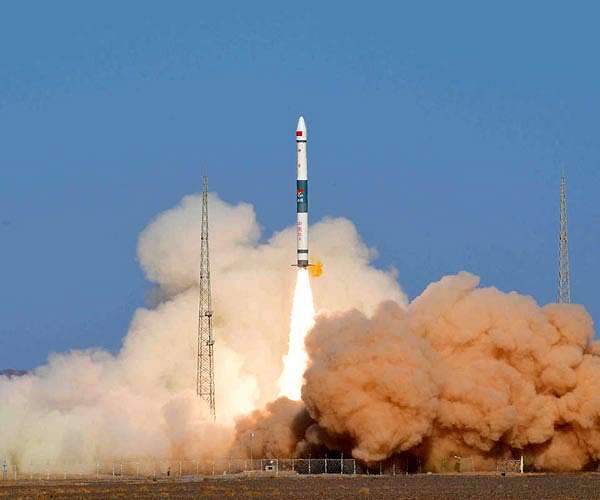
China used a Kuaizhou 1A solid-fuel carrier rocket to launch two experimental satellites from the Jiuquan Satellite Launch Center in the Inner Mongolia autonomous region, with liftoff taking place at 5 pm local time.
The rocket flew from a mobile launch platform and inserted both spacecraft into their planned orbit, according to China Aerospace Science and Industry Corp, which manages the Kuaizhou small-launcher program.
The two payloads are described as experimental satellites focused on communications technology verification, tasked with testing new communications payloads in orbit and collecting data sets that can be used to refine maritime traffic management services.
By operating over sea lanes, the satellites are expected to contribute to monitoring and routing information for ships, supporting applications such as vessel tracking and maritime safety.
This flight represented the 30th mission of the Kuaizhou 1A variant and was recorded as China's 79th orbital mission of 2025, underscoring a continued high launch cadence and the growing role of small solid-fuel launchers in the national manifest.
Kuaizhou 1A is a solid-propellant, road-mobile small launch vehicle developed by China Space Sanjiang Group, a CASIC subsidiary based in Hubei province. The rocket stands about 20 meters tall with a liftoff mass of roughly 30 metric tons and can deliver about 200 kilograms of payload to sun-synchronous orbit or around 300 kilograms to low Earth orbit, aligning it with small satellite and rapid-response missions like this launch.