
Military Space News
UAV NEWS
Bitter cold complicates Ukraine's drone defence

Bitter cold complicates Ukraine's drone defence

By Barbara WOJAZER in Kyiv with Maryke VERMAAK in eastern Ukraine
Kyiv, Ukraine (AFP) Feb 16, 2026

Earlier this winter, Ali's unit was flying an interceptor drone in subzero temperatures on the front when the camera suddenly froze, sabotaging their mission to detect and thwart an incoming Russian attack.

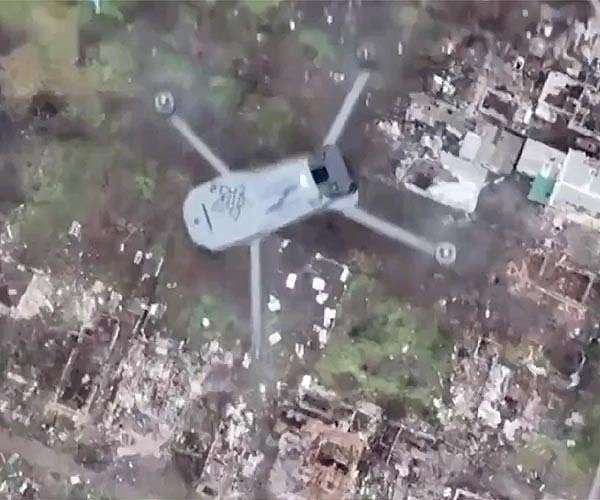
Temperatures across the 1,200-kilometre (745-mile) front line have plunged to their lowest of the entire four-year Russia-Ukraine war, complicating the use of battery-powered drones, central to both sides' military tactics.

"The impact on our drones is completely negative," said Ali, who asked AFP to identify him by his call sign, in line with military protocol.

"Batteries lose charge faster, the cameras and wires freeze, they just ice up."

Both Russia's and Ukraine's army have come to use cheap drones ubiquitously.

Small reconnaissance craft scope out enemy positions and can drop grenades on targets and soldiers, detecting even the smallest movement on the ground below, while others are packed with explosives and designed to slam into vehicles and buildings.

Some drones are now connected to their operators with an extremely thin fibre-optic cable, ensuring the connection to the pilot remains stable and immune to electronic jamming.

Interceptor drones, like the kind Ali's unit was flying, are used for defence -- a kind of drone-on-drone aerial warfare to hobble incoming attacks.

But as temperatures have hit -20C on the front, both the equipment and men operating the devices freeze up.

Near the southern front, pilots from the 18th brigade were getting ready to launch their interceptor drones.

The light polystyrene craft resembles a toy plane.

"Frost, low cloud, fog. In such weather, it is difficult for a drone to fly. It can short-circuit, it can break in the air," said Nazariy, one of the brigade's squad commanders.

- Death trap -

Old-school solutions are sometimes required to help the high-tech devices stay airborne.

Denys Shtilierman, chief constructor at Fire Point, a company making Ukraine's first long-range drones, said rubbing grease over them provided an extra layer of insulation from the frost.

"We just put lard on them and it takes off. I'm laughing, but it's how it is," he told AFP during a visit of the company factory.

The craft have become far too central to the war effort to abandon them because of tough weather.

"Drones are being used regardless of the conditions. We have certain limits, but we need to use them," Shtilierman said.

While the winter poses a technical challenge, in other respects it makes drones an even more potent threat.

When the skies clear, the white layer of snow can quickly turn into a death trap for any troops trying to traverse it.

"It's very easy to see where someone walked or drove because tracks stand out sharply in the snow," said Lafayette, a pilot with the Achilles brigade.

Some drones are also equipped with thermal cameras, which makes the heat they pick-up from human bodies much more visible in winter.

- 'Die from the cold' -

Amid the cold snap, Russia has upped its long-range attacks on Ukraine's energy sites, cutting off electricity and heating for hundreds of thousands of civilians across the country and triggering a major energy crisis.

At the front, Ukrainian forces are also struggling from the cold.

In January, Moscow's army recorded one of its fastest advances of any winter month, according to AFP analysis.

Though several Ukrainian military officials have noted other periods of reduced intensity in Russian assaults due to the bitter cold.

At a recent training session for Ukrainian infantry, an instructor shouted as soldiers ran through thick snow, the layers of ice crushing under their boots.

"Infantry that comes out is literally destroyed because they have nowhere to hide," said Koleso, a 31-year-old infantryman.

In the frost, wounds quickly turn deadly, as hypothermia weakens the body's ability to cope with trauma.

Hypothermia and frostbite on limbs are common, said Nastya, a paramedic with the Da Vinci Wolves brigade.

"The wounded die not only from shrapnel and bullets -- they also die from the cold, which accompanies them like a dark companion in the frost," she said.

"The cold is a very insidious enemy, it should not be underestimated," she said.

Despite these risks, Nazariy said there was no way but to keep fighting, and ensure Kyiv's drones stay in the air.

"We are at war. We work in any weather."

Related Links
UAV News - Suppliers and Technology

Subscribe Free To Our Daily Newsletters
Tweet

RELATED CONTENT
The following news reports may link to other Space Media Network websites.
UAV NEWS
Drones, sirens, army posters: How four years of war changed a Russian city
Voronezh, Russia (AFP) Feb 13, 2026
A drone whirred through a shopping centre in the Russian city of Voronezh as Shaman, an operator for the Russian army, showed shoppers one of the devices that have dominated the battlefield in Ukraine. Hiding his face behind a balaclava, the 19-year-old told AFP he would soon leave to fight in the war, vowing "to defend my country" - which launched a large-scale offensive against its neighbour four years ago. Around 500 kilometres south of Moscow, Voronezh - a city of one million people - is ... read more

UAV NEWS
Leonardo DRS infrared payloads selected for SDA Tracking Layer Tranche 3

AST SpaceMobile secures role on MDA SHIELD defense architecture

Greenland is helpful, but not vital, for US missile defense

Netanyahu says Israel won't let Iran restore ballistic missile programme

UAV NEWS
Raytheon advances next generation short range interceptor with ballistic test

Russian strikes kill 4, wound two dozen in Ukraine

Japan and US agree to expand cooperation on missiles, military drills

Russia claims Oreshnik missile hit Ukrainian aviation plant

UAV NEWS
Raytheon demonstrates recoverable Coyote system against drone swarms

Drones, sirens, army posters: How four years of war changed a Russian city

Drone attacks on Ethiopia's restive Tigray kill one

Poland signs deals for 'Europe's most modern' anti-drone system

UAV NEWS
Balerion backs Northwood to tackle ground bottlenecks in expanding space economy

Aalyria spacetime platform tapped for AFRL space data network trials

W5 Technologies LEO payload extends MUOS coverage into polar and remote theaters

Eutelsat orders 340 new OneWeb LEO satellites from Airbus

UAV NEWS
Lockheed ramps up THAAD interceptor output with new framework deal and Camden facility

US to launch $12-bn critical minerals stockpile to ease China reliance

Japan, Philippines agree military resupply deal

Cyviz awarded two classified NATO defense contracts for mission critical visualization systems

UAV NEWS
China's top general probe to 'remove obstacles' in military: state media

Ukraine, Norway, Sweden top destinations for German arms exports

German intelligence says Russian military spending far higher than reported

India budget pledges record infrastructure and defence boost

UAV NEWS
As Greenland storm passes, US allies focus on stepping up in NATO

The Decline and Fall of Donald Trump

US cuts leave Ukraine aid at record low: think tank

China's Xi calls for 'orderly' world in talks with Uruguay leader

UAV NEWS
Engineered substrates sharpen single nanoparticle plasmon spectra

Subscribe Free To Our Daily Newsletters


The content herein, unless otherwise known to be public domain, are Copyright 1995-2024 - Space Media Network. All websites are published in Australia and are solely subject to Australian law and governed by Fair Use principals for news reporting and research purposes. AFP, UPI and IANS news wire stories are copyright Agence France-Presse, United Press International and Indo-Asia News Service. ESA news reports are copyright European Space Agency. All NASA sourced material is public domain. Additional copyrights may apply in whole or part to other bona fide parties. All articles labeled "by Staff Writers" include reports supplied to Space Media Network by industry news wires, PR agencies, corporate press officers and the like. Such articles are individually curated and edited by Space Media Network staff on the basis of the report's information value to our industry and professional readership. Advertising does not imply endorsement, agreement or approval of any opinions, statements or information provided by Space Media Network on any Web page published or hosted by Space Media Network. General Data Protection Regulation (GDPR) Statement Our advertisers use various cookies and the like to deliver the best ad banner available at one time. All network advertising suppliers have GDPR policies (Legitimate Interest) that conform with EU regulations for data collection. By using our websites you consent to cookie based advertising. If you do not agree with this then you must stop using the websites from May 25, 2018. Privacy Statement. Additional information can be found here at About Us.